
Mystical Tarot Realms

Hover your cursor above BLOG to go to page2, page3, page4, page5, page6, page7,
page8, page 9, page 10, page 11, page 12, or page 13 for new content.
Suite 14, Movement Thirteen:
PARADISE REGAINED
About two years ago, I hiked alone through a high meadow near Tamarack Creek over fallen branches and tree trunks. Where few people had ever ventured, I found arrow leaf tansy and tiger lilies and columbine and spent the morning immersed in rivulets and flowers. After I rested on a rock and ate lunch, a few minutes later my heart started beating irregularly. My stomach felt like a stone that had lurched up into my chest. I thought I was dying of a heart attack and plopped down on a large, flat stone. I leaned back against a pine tree as water gurgled peacefully in the nearby stream until the AFib finally dissipated about forty minutes later. Without knowing it then, I had reached an advanced stage of celiac disease. My small lunch, which had contained gluten, had sent my heart into a frenzy. Many months later, after numerous experiences with AFib, I finally made the connection between gluten and erratic heartbeats, in time to avoid a blood clot or an actual heart attack. After eliminating gluten entirely from my diet, I have not experienced AFib for several years now.
I returned to Tamarack Creek last weekend. After a winter of heavy snowfall, the tiger lilies were blooming more profusely than I've ever seen before. Over 7,000 feet above the San Joaquin Valley, where almost every inch of land has been cultivated and urbanized in the last century, over a mile from Highway 168, the meadow has remained pristine. Near the highway, however, ranchers have grazed cattle that have trampled on a great many flowers, including some rare ones like gentian and little elephant's head, and logging roads snake down the mountain high above the creek on both sides, yet the meadow has managed to avoid molestation, possibly because of so many fallen trees and branches near its edges.
In the meadow, I became the Fool, the eternal child, resilient within fields of change and adversity, knoThanks to my ritual wing long moments of inner freedom without negativity. As the Fool by the creek, for one day I experienced paradise physically and spiritually. I had returned to a paradise not of the id or the ego, but of the higher self, which feels the unity and divinity within all creation. I felt a surge of well-being and a greater sensitivity to the life-force: I sensed the auras of plants and trees tuned to their surroundings. Tiger lilies, so abundant that their fragrance permeated the meadow, hovered above the rivulets and broken branches near waves of golden arrow-leaf tansy and columbine bobbing in the breeze, in a self-sustaining community, interconnected physically and spiritually, that will survive long after the human race has perished—if we leave it alone. I felt the life-force thrilling through me and through all the plants and animals in the forest.
Back in the city, I realized how little I have been in touch with the life-force, which has as many names as there are civilizations (1). The life-force can't be found in our devices, but you can't tear those devices out of my hands or the hands of most children and adults these days. The life-force does not exist in movies or TV shows, yet it's extremely hard to get me to avert my eyes for even a few moments once I start watching. The life-force is not in my car or my furniture or my house, only the residues of human elemental energies. I began to understand why forests might seem like pure chaos to people who are only used to human order, why so many people have become terrified of the life-force as it manifests in nature, why in the past thirty years I have encountered in the wild only a handful of other people, most of whom were carrying fishing rods or rifles.
As I stare at my computer screen, I realize that in this information age, it has become so easy to lose the knowledge about how the life-force manifests within ourselves and the other creatures of the Earth. So many people are obsessed with the body but know nothing about the subtle energies of the aura or the chambers of the soul. So many are aware of cartoon super-heroes but are unaware of the Gods and Goddesses that personify powerful natural forces.
After I returned to the meadow, I realized that I had returned to something like the self I had known many years ago, undistorted by social conditioning. I retained the knowledge and wisdom that I have gathered over the past fifty-six years but felt free of decades of negativity.
It became clear to me why I had never fully discovered the knowledge of the life-force within me. As a child I was regimented in the public school system for nine months of the year but had three months of freedom every summer. When not playing sports or hanging out at the mall during summer vacation, I was watching TV or going to the movies. Inevitably, during the last half of the summer, I spent less time with friends and more time watching TV. In fact, the TV was on all the time, even during meal-times; I was socialized year-round to become a productive unit of labor and a spendthrift consumer. When I grew up I was going to buy, buy, buy junk food and clothes and cars and furniture and houses. I would go to college just so that I could get a great job and afford so many awesome things.
Money is a type of human energy but does not contain the life-force. Cars have a type of power but not the power of the life-force. Clothes and furniture and houses accommodate our needs and reveal our status in society but do not contain the life-force. For decades, in public schools, at home, at malls and amusement parks, at the movies, in college, I starved for the life-force.
When I was growing up, by the end of each summer vacation, I was bored to tears. I lived in a comfortable middle-class home, but by the end of summer, I felt an incredible emptiness, except when I was reading about art or creating something. My father, fortunately, took the family on camping trips that sometimes lasted a week. Those camping trips exposed me to a completely different order of life. I at first believed that humans are more special, more intelligent than any other creature, that nature was simply a playground or a kingdom to conquer. Even though over the years I began to recognize the sentience of plants and animals, I had become so brainwashed that I did not even notice the beauty of flowers and trees until my early thirties. As I was growing up my social conditioning slowly disconnected me from the life-force in all of its stunning beauty and diversity, so I could not experience the divinity in nature—I was not even aware that I have a higher self because I did not recognize the life-force in myself; I had not experienced my own divinity, so I could not connect with the divine subtle forces within nature and the cosmos.
I have since my teenage years felt more than a little compelled to escape my social conditioning due to illness and a gnawing sense of emptiness, but since my first experiences with Afib, I have felt an especially keen desire to break free of social constraints and leave my society far behind. I have no desire to “break bad”; on the contrary, I want to be free of negativity, without inner conflicts or chronic physical pain so that I can pursue ideals of beauty, truth, justice, and harmony. Due to my rituals, I may have finally succeeded, at least to a degree. I still feel greatly fatigued at times, and negative memories continue to surface now and then (but with far less force). I don't claim to have totally healed my mind or my body, but for the past few days, I have felt free the way I sometimes did as a child--except now as an adult, I don't feel ubiquitous fear or the weight of parental and societal expectations. I don't need to maintain even a tenuous connection to the herd. After a long stretch of illness and spiritual dullness, I feel as magnificent as a tiger lily, and I can glimpse spiritual magnificence in other people as well.
The Four of Pentacles
After my recent rituals, I feel sometimes that I am at a place in consciousness where the soul meets the divine. Many people no doubt just consider me crazy. Some people have made me feel less than worthy at times, but I realize that the more I let go of negativity in my body and mind, and the more I feel powerful subtle forces, the more I feel healthy and free. I know, though, that with a chronic illness, feeling positive about myself is not going to happen 24/7.
Due to social conditioning and my chronic illness, I have searched a long time for health and freedom. Long before my recent rituals, for instance, I chose not to be ruled by any particular symbol system. I pick and choose the symbols from various cultures that I need in my spiritual work. Identifying with the symbol instead of the spiritual force has led to untold madness, with cultures forcing each other to adopt their symbol systems through oppression and violence. A symbol system does not contain power until people connect with the subtle forces that the symbols represent; people who are forced to worship a symbol are unlikely to connect with its power. It is this very act of breaking free from the tyranny of symbol systems that leads to much greater freedom. Connecting with spiritual principle and spiritual forces is essentially what matters, not any symbol system, not Christianity or Buddhism or Hinduism or the so-called “dead” religions that we consider myths. Authentic spirituality for me is about the soul aligning with the divine spark and connecting with the forces of Being. Myth, which is about all that any religion amounts to, is merely one way throughout history that people have used to achieve those ends. The unseen forces do not change, only the symbols.
Stepping away from the herd does not mean ignoring laws and values. Once I had the Vision of Harmony and understood my own divinity and the divinity within nature, I understood that my soul is a tiny thread of consciousness in one vast tapestry of energy. Everything is connected. I shrink from the thought of harming anyone or anything because I am part of who or what they are; I would be harming myself by harming others. Until every person internalizes that simple spiritual principle, laws that prohibit harming others must stay in place, and we will continue to label unbalanced acts as sins. A person who internalizes spiritual principle would not dream of harming or killing another, except in self-defense. That is why I have said that the only true sin is having a value system that cuts you off from knowing all the vibrations of the life-force because that also cuts you off from knowing the interrelationship of all things. The lack of inner awareness of the life-force and spiritual laws can lead to harmful and horrific acts. Lack of empathy, which stems from an ignorance of the divinity of nature and the self, can lead to ecocide and genocide.

Lupine and Poppies


Blue Dick and Poppies
Suite 14, Fourteenth Movement:
REBOOT, REFORMAT
I think I've always known that I would need to leave my society far behind in order to heal myself on the deepest level, which explains why for many years I have journeyed into the woods at every opportunity. For me, at some point on just about every trail in the Sierra Nevada Mountains, I have lost my personality, then my soul surfaces; I sometimes even experience knowledge that transcends my five senses and intuitions about events in the future as well as events beyond the range of my perception. On each trail I also experience anticipation and dread because with that shift also comes the fear of annihilation of my identity. Authentic spirituality, I believe, cannot exist without that moment when the personality vanishes and the divine spark communicates with the soul, and the soul communicates with the conscious mind—the psyche aligning.
When I was in junior high school, I was a jock, and I hung out with other jocks at recess and at lunch. We would usually roam the halls as a herd without ever saying a word to one another. We were members of the “in-crowd,” providing protection for each other, clearly showing the other kids that individual members of the group were not to be messed with, ever. After about six months as a member of the herd, I felt a strange emptiness as we drifted through the halls. I turned my head and gazed at the boys beside me and realized that I had not said more than two words to any one of them. One day I couldn't stand the feeling of emptiness any longer. I started hanging out with someone who was less "cool," more vulnerable socially, but far more fun.
So often as I was growing up, I just went around on auto-pilot, half-asleep. My family and my society conditioned me to maintain the unexamined self as a survival mechanism. I adopted their beliefs and developed physical, emotional, mental, and spiritual habits as I learned to play by the rules. In the process, I became passive, allowing others to control and manipulate and crush my imaginative powers, and it was this very habit of inner passivity that became a veil within my consciousness. Even though these habits and beliefs interfered with my ability to live fully and creatively, since nothing challenged my belief systems too much, and life didn't treat me too badly, I remained passive and didn't question anything. But as I grew up this tower that I was building was hit by lightning. For me a thunderstorm formed from the inspiration and exultation I experienced within nature and the arts, and that, along with my chronic illness, compelled me more and more to step away from the herd.
The more I separated myself from the herd, the more I became aware of my ego, which I realized is concerned primarily with survival and gratification, not with sympathy and union. After many years away from the herd, I recognized that my ego has dominated my soul, my higher self, driving it deep into my subconscious, so far down into the depths of my subconscious mind that for over thirty years I was not even aware that I have a higher self. As soon as I began to live more in the higher self, I recognized that my ego is willing to compromise the truth for security and status—my soul is not. I am keenly aware now that those who step out of the herd and insist on truth are often treated as troublemakers and traitors. Fortunately or unfortunately, now that I am aware of the higher self, I cannot turn back and live in the personality that my ego has formed, even though it is often more painful to live in the higher self. My soul has shaken up my ego without any apologies whatsoever. At times Mars is a lot like Shiva, burning away everything except the essence of the soul. When Mars burns the transitory away, the spirit remains.
I realize now that over the years my excursions into nature, my spirituality, my art, my blogs have all pointed me to one key event: rebooting, reformatting, and installing a new operating system. In other words, I have to dissolve my conditioned self, access my divine core, purify, and rise from the ashes. I hope to retain all my software, my memories and knowledge and wisdom, but lose my ego and cleanse my soul so that I am completely renewed. Hopefully after that when I recall bad times, I will remain detached as I experience the memories, like when I'm watching a video.
With global terrorism, the proliferation of weapons of mass destruction, environmental degradation, species extinction, global warming, overpopulation, the volatility and cruelty of capitalism, and on and on, humanity is approaching a time when many of us will need to reboot and reformat as well. The more I purify my mind and lose my sense of ego and personality, the more I see how much conditioning has thwarted my creativity and fragmented me, how deeply I have been damaged, physically, mentally and emotionally, by my disease and by the herd instinct. Our problems collectively are becoming more and more acute—a reflection of the deep inner conflicts and schisms created by social conditioning and the veils within consciousness. Cleansing our psyches and becoming balanced is truly a revolutionary way to manifest harmony in the world. All other revolutions are just noise and violence in comparison.

Ithuriel's Spears and Ground Lupine
Suite 14, Fifteenth Movement:
ARROWS VERSUS TANKS
When I first became a political activist, I assumed that simply presenting an effective, reasonable argument to a body of elected officials would magically open their hearts and minds and make them do the right thing, but I quickly found out that people in power rarely pay attention to citizens who do not have conspicuous political influence. Elected officials are keenly aware that being an activist in the San Joaquin Valley is like stepping with a bow and arrow into a mine field to face the tanks of a well-equipped army, so they tend to pay attention only to individuals and organizations with political fire-power. When I first stepped into the political arena, to my great chagrin I discovered that I was easily dismissed as “misinformed" and “un-American" like other activists working for sustainable communities. That all changed when I started knocking on doors for a conspicuously effective but ill-fated group that gathered a massive amount of local grassroots support through canvassing.
My introduction to local politics occurred around the time of a federal investigation known as “Operation Rezone.” Local jurisdictions are required to adopt general plans that maintain a high quality of life for the community, particularly through smart, sustainable growth. In the Valley, however, developers tend to chomp at the bit for local jurisdictions to adopt general plans so that they could get down to the business of amending them. Rumors of bribery and extortion circulated widely in the Valley, but it wasn't until the 1980s, as developers began speculating on farmland at the edges of towns, that developers and politicians blatantly made a mockery of zoning laws and general plans.
One lobbyist, proud of his ability to influence local elected officials, drove around in a car with a license plate that read, “REZONE.” A federal probe only began in 1994 after a Clovis City Councilman told an influential developer that he wouldn't get his property in the city rezoned to “residential” unless he paid a $10,000 "fee." An investigation finally commenced after the developer started working with the FBI to gather evidence of the shakedown.
The San Joaquin Valley, once a vast wildlife area fed by rivers flowing from the Sierra Nevada Mountains, by the late twentieth century had become almost completely cultivated and urbanized, with wetlands dwindling to four percent of their historical levels. Herds of deer and antelope and tule elk, as well as the predators who stalked them, had vanished in less than a century. The “natural” areas left in the Valley were farms and river bottom areas and a few wildlife refuges. By the 1980s, activists in the Valley fought to protect farmland and wetlands as well as air and water quality, caught in a seemingly never-ending political and philosophical battle between the rights of the individual property owner and the rights of the community.
Activists at that time had to have an especially thick skin. One activist testified at numerous public hearings before local elected officials who usually dismissed or ignored his logical arguments. He continued to participate in local land use meetings week after week even though elected officials continually questioned his credibility--if they paid any attention to him at all, revealing that one voice carries little or no weight--unless backed by money or massive public support.
Ignored on a political level, he chose to work his way through the legal system, demanding higher review of local land use decisions. In one case the activist claimed that a prominent developer had not adequately addressed the precedent-setting and growth-inducing impacts of a subdivision in the floodplain of the San Joaquin River. The judge fined the activist $300,000 for pursuing a "frivolous lawsuit." The judge claimed that the activist, despite going on public record, had not established an adequate record on which to base a lawsuit, calling into question what can be legally deemed an “adequate record.” Since the developer opted not to open his books for review of the “damages," the judge reduced the fine to $100,000.
Being acquainted with the law, the activist appealed the case and won. The developer then turned the tables and appealed that decision, eating up more of the activist's time and money and edging him toward financial ruin.
Another activist, hoping to preserve dwindling farmland, sued his county for inadequate environmental review of a rezone application after elected officials had ignored the concerns of his organization. The developer essentially wanted to create a new business district on farmland between two neighboring towns, which would induce massive urban growth. The lawsuit succeeded in convincing the developer to set aside a few acres of farmland in perpetuity as mitigation. After that bit of success, a county official phoned the activist and revealed that the school district “had been informed” that the group’s activities were “immoral.” Coincidentally, the activist’s school district from that day forth stopped calling him to work as a substitute teacher.
All laws can be amended, but zoning laws are particularly vulnerable to alteration. In the Valley and many other places, great public pressure must be brought to bear upon politicians to keep them from amending general plans and altering zoning laws to allow development on agricultural or open space areas. Organizing this level of public opposition is not an easy task, especially when most organizations rely on volunteers.
There are basically two ways that democracy actually works in places like the San Joaquin Valley: You can develop a strong relationship with sympathetic elected officials or establish a large base of public support for your position on an issue. Both are daunting tasks and are seldom combined as strategies due to the limited time and resources of groups that rely on volunteers.
Politicians tend to become sympathetic to your cause if you help get them elected, which takes a lot of grueling volunteer work, and even then politicians won’t necessarily lean toward your position on an issue since they work with other organizations and contributors and politicians in a system where quid pro quo greases the machine. The other tactic, establishing a large base of public support for a specific issue, works well at a local level, especially in areas like the San Joaquin Valley where city and county officials are surprised by citizen participation. This method, which necessarily focuses on one side of the issue, is often perceived as adversarial by politicians and vested interests.
I know because for several years I organized and led a coalition of local environmental groups while I canvassed three days a week. Backed by massive public support gained through door-to-door canvassing, the coalition inevitably became extremely effective--the leaders targeted and undermined.
My organization paid its canvassers half of what they raised, which still ruffles the feathers of purists who believe that true organizing is only accomplished by volunteers--even though, oddly enough, politicians and developers are not asked to force their children to go hungry. If we did our jobs as canvassers, we made enough money to survive, which kept us from being targeted as troublemakers in the workplace (not uncommon in a society where you can be fired for chewing gum and not going in on your days off or getting sick too many days--even with a doctor’s note). When an activist loses a job, whether or not the activist’s political involvement is the real cause, his or her days of political organizing are usually over.
We gathered massive public support through signatures on petitions, letters to elected officials, and contributions of any size, and the organization became an effective, powerful machine. Doors were slammed, threats were made, and guns were occasionally pointed in our faces, but we kept knocking on doors night after night, identifying and activating supporters. Local politicians finally paid attention and became hesitant to threaten or ruin or blackball individuals who participated in the democratic process--due in great part to the conspicuous public support gained by canvassers.
Public hearings became truly beautiful events. Individuals and representatives from many different organizations would stand before elected officials and give effective and impassioned testimony. Even though we never orchestrated the testimony beforehand, each person who testified tended to focus on a different facet of the issue, creating a powerful cumulative effect. Democracy was actually working and the good ol’ boys who machinated behind closed doors had to operate in fresh air and sunlight. Sometimes, even after they had received the required permits, developers would later give up on a project, such as a hazardous waste incinerator, because of what they rightfully perceived as overwhelming public opposition.
Mushrooms next to a Stream
Hardcore political organizers were no longer labeled “un-American” or dismissed as “uninformed” at public hearings or in the press. I had been continually amazed that elected officials could so easily toss out a term like “un-American” at citizens who were obviously taking great personal risks by participating in the democratic process in the first place. Apparently these officials meant to imply that any citizen who interferes with an American's right to “make a buck"--a corporation’s inalienable right to make money, in other words--is either a communist or a socialist--while also suggesting that the citizen is so void of patriotism that he or she is both immoral and unemployable.
As soon as my organization became effective, trouble descended upon it from every side. The office was broken into several times, and the organization was evicted from the office complex--for overdue late charges. A sexual harassment lawsuit, which named a canvasser and several directors (for allowing a hostile environment), was brought against the organization by an employee who had also conspired to form a copy-cat group without a board of directors that lured veteran canvassers away from the original organization by promising higher pay under the table. Unfortunately, settling out of court proved much cheaper than a legal battle. The Fresno Bee placed the organization’s recruitment ad under “Sales” to create the impression that canvassers would be selling door to door. The final nail in the coffin was an article in The Fresno Bee by a respected journalist who, without stating his sources, claimed that the organization kept one hundred percent of the contributions, which was, of course, false, a total lie.
The organization was a not-for-profit citizens group, not a charity, and worked for those who didn’t have the time or the money or the knowledge or the temperament to participate actively in the democratic process. People gave money and support to fuel an effective political machine that represented their point of view--a powerful force that included canvassers who alerted and activated the public on a large scale as well as directors who organized issue campaigns and testified at public hearings. (I’m sorry, but I can’t help but believe that the “respected" journalist who implied that the organization was crooked had to be either blind to political realities or a total sell-out.)
After the organization closed its doors, community organizers went back to suing local governmental bodies, usually for inadequate review of the environmental impact reports, and elected officials went back to ignoring the general public.
Unfortunately, success in the courts only throws a project back into the laps of the same elected officials who approved the original permits in the first place--for further review of the report’s legality, not for further examination of the project’s potential harm to the community. As long as an environmental impact report is properly laid out, a project can admittedly contain numerous and severe “adverse impacts," and a body of elected officials can legally approve it. The process depends on citizens’ groups holding elected officials accountable for their decisions. In addition to advocating for a specific position on an issue, a group of canvassers can also go night after night into an elected official’s district and let the public know how the politician, on behalf of vested interests, is attempting to gut beneficial legislation or who is voting for harmful projects.
Going to court is a last resort that only reveals the public’s ineffectiveness on the political level. Going to court requires a high level of expertise, far beyond the range of most college graduates. And going to court is extremely expensive. Instead of using contributions to alert the public and gain political support, an organization can instead spend tens of thousands of dollars on court costs, which can soon land them in bankruptcy court. Instead of using the contributions to support activists, the money goes to lawyers who can only stall a project, not stop it in the political arena. (This strategy can also lead to the “adverse” consequences for activists that I have already mentioned above.) Yet for some reason going to court is still a respectable strategy, far more respectable to many people than the more grassroots method of canvassing door-to-door.
Unfortunately in places like the San Joaquin Valley, activists often end up twisting in the wind, no matter what method they choose. On a personal level, after finding myself in that unpleasant position more than once, I became cynical and bitter and dwelt more and more on the negative.
It’s hard not to become bitter and cynical if you are an activist in the San Joaquin Valley, and negativity is extremely bad on the spiritual level, creating blocks to higher awareness. After a decade or so, I stopped dwelling on the negative and am now focusing on positive spiritual energies as much as possible as one way to overcome a chronic illness, but I am sincerely sad--perhaps a better word is "horrified"--to say that the usual corruption of democracy continues, especially in the Valley now without any effective opposition at all.

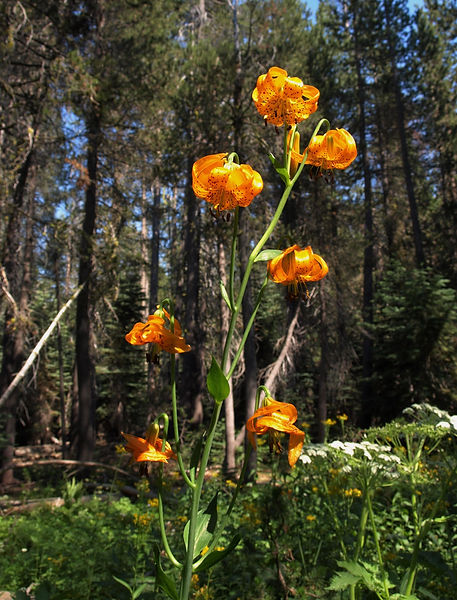
Tiger Lily in a High Meadow
Suite 14, Sixteenth Movement:
THE TIGER LILY AND THE GLORY
"Consider the lilies, how they grow: they neither toil nor spin; but I tell you, not even Solomon in all his glory clothed himself like one of these. But if God so clothes the grass in the field, which is alive today and tomorrow is thrown into the furnace, how much more will He clothe you? You men of little faith!” Luke 12:27-28.
“It is no great measure of health to be well-adjusted to a profoundly sick society.” Krishna Murti.
Sometimes when I am hiking in the mountains, I find a flower that makes me want to question everything I've ever learned. Encountering a tiger lily in a high mountain meadow, for instance, I have felt the energies of the sun and the Sun behind the sun within the petals and leaves and in the surrounding plants and trees. I had once, long ago, believed that God was in some far away heaven. Then for many years I believed that God does not even exist. Over the years, however, I have kept finding myself before a majestic flower such as a tiger lily, sensing divinity in all creation. Inevitably among the wildflowers, in fresh air and sunshine, I sense light radiating through my solar plexus and feel, as I breathe, the magnificence, harmony, and abundance of the natural world. After numerous encounters with ravishing flowers and awesome trees, after visions of spiritual symbols during meditation, I have ended up finding a different belief system that reveals the magnificence, harmony, and abundance of both the spiritual and natural worlds.
Not enough is made these days of the benefits of fresh air and sunshine. Recently, at seven thousand feet in elevation, after escaping the pollution and the negative mental atmosphere of human society, I felt a surge of well-being so powerful that I couldn't help but entertain a horrible thought: Humans have created societies so polluted and so cut off from the energies of the life-force that many people think that the Source does not permeate all of creation or plants and animals and ourselves.
I had another uneasy feeling: I have formed false beliefs that for most of my life have made me feel less magnificent than the tiger lily, less full of the love, harmony, and abundance that, in the fresh air and sunshine at seven thousand feet, I suddenly knew all humans can experience.
I did not know that the natural world is full of splendor until I explored every trail through the forest that I could find. My wife told me at the beginning of our relationship thirty years ago that you must have flowers and trees and birds in your heart to truly see them. I have come to realize the truth in that statement: You have to open your heart in order to truly see anything or anyone. I did not know about the paths through spiritual dimensions until I opened my heart and mind during meditation and experienced visions of magnificent symbols: a golden, equal-armed cross with archangels at each end; a golden plate and chalice on a brilliant white tablecloth; a gray infinity symbol above my head; a brilliant white thousand-petaled lotus with a diamond in the center; a golden crown; three five-petaled roses; a golden Celtic Cross. Eventually I found some of these symbols in the awesome symbol system known as the mystical Tree of Life.
Fresh air and sunshine, I have discovered, give me a much clearer perspective. I realized that to be well-adjusted to a sick society I end up being sick. And, because the Valley is so full of pollution and negativity, I must struggle continuously on all levels: physical, emotional, mental, and spiritual. Unfortunately, in my current physical condition I cannot continue struggling with this sickness--I still hope to survive to a ripe old age.
Recently I spent a few days enjoying fresh air and sunshine at the beach and realized that I have a perspective on the central coast that only a few people have. Forty-five years ago, when I was eleven, my family visited the beach at San Simeon. Starfish, crabs, sea anemones, barnacles, mussels, and kelp tapestried the rocks. A few sea anemones seemed larger than my head, and I was tempted to stick my fingers in their mouths, but I was afraid that they would bite off my hand. I returned years later, only to discover barren rocks: Instead of starfish and anemones and barnacles I found patches of black tar stuck to denuded sandstone. At first I had the nagging feeling that something was missing. After awhile, I realized that the marine life along the shore had been wiped out, most probably, given the prevalence of tar, by oil spills. No one else with me that day had experienced the abundance of life that had once flourished there. To them, the sea shore appeared to be as it had always been. They had no notion of how the life-force had once manifested within countless creatures along the shore.
It took a short time to wipe out the marine life along the central coast, yet only now, decades later, is the ecosystem showing a few signs of recovery—a few small anemones in the tide pools, for instance. After reading that half of the world's wildlife has disappeared in the past forty years, I'm beginning to think that as a species we are amazingly good at ignoring our impact on the planet (1). Or perhaps it's even more basic than that: Out of sight, out of mind. If we can't perceive something, we have great difficulty believing that it exists or once existed, just as I didn't believe in spiritual symbols until I experienced them in vision, just as I did not believe that nature is full of splendor until I experienced amazing wildflowers.
The losses, of course, are due mainly to cultivation and urbanization and pollution and the need for food in an increasingly overpopulated world, but how easily we forget the threads in the divine tapestry when they are gone. And those "threads," I've discovered, are just as important as spiritual symbols in helping me know the Source. Over the past half century, I have noticed a correlation: The more I experience the divinity of the life-force within creation, the more I experience the divinity of the life-force within myself. Conversely, the more I forget how the life-force manifests in other creatures, the more I forget the divinity of the life-force as it manifests within me.
The more we forget, the more we are likely to see the world only in human terms. The San Joaquin Valley, where I have lived for forty-five years, over the past hundred years has changed dramatically from an ecosystem with an abundance of wildlife to a patchwork quilt of farms and ranches and cities. John Muir, upon entering the San Joaquin Valley in 1868, noted in a letter, “The valley of the San Joaquin is the floweriest piece of world I ever walked, one vast...sheet of flowers” (2). I was startled to read Muir's letter because I had traveled numerous times across the Valley before I encountered any wildflowers at all—a few baby blues and poppies on a stretch of ranch land. We forget that before the Valley was cultivated and the dams were built, the San Joaquin River would flood periodically, refreshing the wetlands and aquifers, creating a flyway where birds would blot out the sky, where herds of deer and tule elk and prong-horned antelope would roam. Since the 1940s, the San Joaquin River, due to water diversions, has died at a sinkhole most years instead of flowing out through the San Francisco Bay into the Pacific Ocean. Wetlands now are down to four percent of their historic levels, and the wildlife population, found primarily now on a few small refuges, has dwindled to almost nothing. The loss of what little is left is continuously couched in human terms: jobs and homes and people versus species of wildlife--and industry and business continue to dominate. Because fewer and fewer people have experienced the magnificence, harmony and abundance of nature, the political will to protect what's left in places like the San Joaquin Valley has nearly evaporated. The splendor of nature and the life-force continue to vanish.
Forgetting creates a disconnect, a moral chasm. During droughts farmers keep demanding more dams in the foothills, ignoring the fact that farming and ranching and cities have already destroyed a vast, once-thriving ecosystem in the Central Valley. They ignore the fact that dams in the mountains would destroy more ecosystems so that the public would have even less access to nature in all of its stunning manifestations. I would not have known the sacredness of rivers and forests had I not dedicated myself to experiencing wildness on a regular basis, often in places where farmers want to build dams. So many nowadays do not experience wildness at all. So many people, rarely experiencing the interrelationship of life in wild places, have not come to know and revere the life-force in plants and animals and the ecosystems where they live—or in other people. Ecocide, another example of the sickness of our society, threatens the very fabric of nature, yet once again the hydraulic brotherhood is planning to commit ecocide for its own benefit, angling for taxpayer funds to dam stunningly beautiful public lands in the foothills near Fresno.
Please don't think that I am romanticizing nature. Humans are struggling like every species to survive in a predatory universe. After many excursions into the wild, however, I no longer consider horrible either predation or death. All creatures end up sacrificing themselves for other beings, even if only for ants and flies, which are essential for the health of the world. The transition from the physical to other dimensions occurs as regularly as birth into the physical realm. My soul has floated out of my body more than once, and during those experiences I realized that our bodies are vehicles for eternal consciousness. I no longer fear death, and since I have experienced divinity within life, I know that divinity exists on the other side as well. Since I am open to death, I am open also to the magnificence, harmony, and abundance of life.
Ecocide, which occurred in the Central Valley not long before I was born--and along the central coast during my lifetime, has made it ever so much harder to know the magnificence, harmony, and abundance of spirit because in those places the magnificence, harmony, and abundance of the natural world has vanished. Dion Fortune states in The Mystical Qabalah, “matter is crystallized spirit, and spirit is volatilized matter” (3). The remaining ecosystems in the mountains could very well save this society if enough people recognize the Source in all things and get in touch with the divinity in nature and themselves and other people.
After hiking through the mountains regularly for many years, I have also come to believe that a typical city street is far more dangerous than a trail through a forest. I have encountered bears and mountain lions and coyotes and bobcats and rattlesnakes and tarantulas and scorpions but have never once been threatened by any of them. I cannot say the same about people--especially people driving cars.
The inability to perceive divinity within nature stems in large part from fear: the fear of otherness, the fear of shattering the ego, the fear that if we stop controlling nature we will never have enough—for survival. During my recent trips to the mountains and the ocean, I realized that my entire life I have been fed a lie: I will be special and respected if I fulfill certain conditions, such as making tons of money, buying a big house and/or a hot car, or achieving exemplary status in some career. Due to my worsening chronic illness, I touched the hem of eternity over a year ago, and I have realized since then that, like the vast majority of other people, I have just kept doing pretty much the same things over and over in the same places for most of my life and that I will never, no matter my circumstances, be more or less significant than any other creature or person on this earth. I have realized that every living thing is magnificent, not for what it does, but as a divine, transitory expression of the life-force within the web of life.
(1) http://www.cbsnews.com/news/world-wildlife-fund-wwf-half-the-worlds-biodiversity-gone-over-last-40-years/
(2) http://www.muirrambleroute.com/muir_journal/IV.SJoachinValsyn.htm
(3) Fortune, Dion. The Mystical Qabalah, p 214. London: Society of Inner Light, 1998.

Pestle in a Pounding Stone
Suite 14, Seventeenth Movement:
ACCEPTING THE WORLD
I often hike in the Sierra Nevada Mountains just to encounter stones. Some rocks, though resembling magnificent spires or edifices, confront the soul with a sublimely nonhuman order. Other stones covered with moss and humus seem as alive in their niches as anything else in their ecosystem. Though forever silent about human and natural history, some stones contain traces of a Native American presence that in the Sierra Nevada Mountains has all but disappeared within the last century or so, the mortars filled with grass, humus, water, sometimes even pestles. A vibration from eon's ago, perhaps from the beginning of time, permeates stones: Occasionally in the mountains I am so impressed by the primordial energy of stones that I feel a crazy desire to kneel down and worship them.
The energies within stone and earth form the physical ground of being, which has existed far longer than the human race, far longer than any organic life on the planet. These energies establish the basic reality around which countless forms of life have surged forth only to pass away, enabling other forms to fill their niche. These energies are the bedrock of creation itself, but they also usher in the King of Terrors, for whatever tabernacles in physical form must perish. Because all form eventually breaks down, even the tallest mountains, the Gods of creation also force us to face the inescapable realities of suffering and death. The life-force is in a field of constant change, of creation and destruction, which allows the new to supplant the old in a never-ending cycle.
The Gods of creation have birthed forms beyond the human race's ability to conquer or control, live volcanoes and vast mountain ranges and endless deserts. Tiny humans huddle on firm, flat ground as much as possible, often ignoring or forgetting the intimidating forms of nature, yet something within us longs for places with sublime natural forms that tower above us—for contact with another order of being, primordial and majestic, that humbles and amazes us and reminds us of the vastness of space and time as well as the planet itself.
The soul needs to be fed as much as the body. As revealed by the Tree of Life, there are ten energetic states, or chambers, of the soul corresponding to the Tree of Life, each of which requires a constant influx of the corresponding energy of its vibrational level. The level of the energy of the womb of creation is very high, associated with the supernal Sephira (Emanation) on the Tree of Life known as Binah. Since this state is on the other side of what the Qabalists call the Abyss, usually beyond human brain consciousness, the soul must be very still and calm to tune to this primal energy, as still and calm as a stone.
The World: Saturn
The ancients fashioned Gods that represent the basic forms and energies of creation, from Ptah in Egypt, to Cronus in Greece, to Saturn in Rome. My soul opened to the energies of the physical ground of being after I had hiked many miles through the mountains, so impressed by rocks, large and small, that I recently invoked the ancient God Ptah. Saturn is perhaps the symbolic form of the primordial Gods of Creation most recognized by modern human beings. Saturn's Greek name is Cronus, Father Time. Associated with the Grim Reaper, Saturn rules our subjective sense of time, including our sense of mortality. In a human being's short span of life, Saturn is the crucible that burns away trivial or artificial characteristics. Saturn's pressure keeps you focused on your own path even if you find that some goals force you to plod through great difficulties in order to establish inner wisdom and discipline—even though all the while fear and regret may accompany you. Known as the “greater malific,” Saturn, the most feared planet in astrology, demands that you accept your true nature, your higher self, and take control of your life, finding what must be done to avoid or solve problems. Tests and trials occur so that you know and accept your higher self and face obstacles with wisdom and courage. Saturn never promises success, but through discipline and perseverance, and by avoiding distractions and overcoming doubts and gaining knowledge and skill, you can earn mastery regardless of the outcome.
Similar in many ways to Saturn, the ancient Egyptian God Ptah is the fashioner of the egg, who dreamt creation and called the world into being, his name meaning “the opener,” in the sense of opening the mouth to speak the Word. From chaos he fashioned the universe through harmonics and thought and established the harsh discipline of form. As the creator of form, like Saturn, Ptah is a God of restriction and stability and obedience to structures that serve individual or collective purposes. On the personal level also, Ptah is a God of planning and determination, of boundaries and limitations.
These days I appreciate the more frightful aspects of Saturn because as a teenager I experienced a great deal of confusion and fear about death. Not long after my grandmother passed away, a year after my grandfather died, my cousin and his girlfriend, both in their early twenties, were killed in a car accident. I was fourteen. The entire family was devastated. A few years later, my father died, three days before his fifty-sixth birthday, about a month after I turned seventeen. I remember seeing him laid out on a single bed in his best suit the day my mother picked out his coffin. His face was waxy and unnatural; I could tell that the embalmers had attempted to make it seem like he was just sleeping. That same day my mother opted to purchase a concrete vault for the casket that would purportedly survive fifty years instead of twenty-five—for twice the money. Almost fifty years have passed since then.
All my other relatives who had died were placed on display during visitation and seemed pasty and slightly misshapen, as if someone had replaced the real body with a poorly rendered, life-sized doll. Sometimes shocked by their almost real-life appearance, I thought that I might be expected to pretend that they weren't dead. Whatever the reason for their appearance, I found that I couldn't grieve openly; my formal clothes, the limousines, the hasty ceremonies, the flowery grave sites all felt unreal. The only time I experienced true grief was during my cousin's funeral when my uncle lifted from the coffin his son's hand and wouldn't let go. He and my aunt wept uncontrollably, which caused me to bolt, sobbing, out of the funeral chapel. After my father died, my surviving family never talked about death, and my friends avoided me, as if my presence might somehow summon death into their world.
In the physical world, things fall apart. People suffer from defects and illness and pain. As someone who has experienced a chronic illness for forty-five years, I know that even people close to you often remain in denial about your illness or blame you for not overcoming your condition. They act like they would rather just avoid dealing with it and would prefer that you would just function normally in the social arena and in their presence. Like death, illness triggers the self-preservation instinct.
Unfortunately I could not remain in the career that I had chosen because illness interfered at every turn, so I have suffered regret, partially because I could not live up to other people's expectations. Since people often avoid you when they learn that you have an illness, even one that isn't contagious, I have grown more and more solitary and misanthropic. After a recent trip to the mountains, I realized that I needed to honor the ground of being, the basic energies of existence, which include suffering and death, and I needed, as a person with a chronic disease, to let go of regret in order to live more fully.
I have often wondered if people can truly experience the vibrational levels of the life-force if they are in denial about suffering and death. If we cannot grieve or suffer openly, if all hint of death and illness must be hidden from sight so we can pretend that they don't exist, aren't we shutting out the life-force? If we glorify youth and strength and ignore aging and illness and weakness, aren't we also ignoring the life force in all its manifestations? If we shut down emotionally when faced with suffering and death, can we truly live?
As I mentioned in a previous post, my soul has floated out of my body several times during illness. I could see everything clearly even though I wasn't using my eyes--including my body below me, and I realized that the body is a vehicle for eternal consciousness--an amazing vehicle that is incredibly resilient. Humans have survived many different environments over the years, and I have begun to understand that we have evolved the characteristics of intelligence, willpower, discipline, and skill at least partially due to the challenges and the harshness of different environments, so I honor the earth and the stones and humanity and all the creatures that have survived for many thousands of years. We are all connected on this planet by the ground of being and by the unity of all creation.


Bush Lupine and Poppies at the San Joaquin River Gorge
Suite 14, Eighteenth Movement:
SPIRITUAL ECOLOGY
Whenever I venture into the unknown, I search for signs of undisturbed grace, and I must confess that I continue even in middle age to risk my life to find places unmolested by humans. Once, when as a young man I was just beginning my quest for the pristine, I encountered a skink on a trail next to a stream. It gazed at me for twenty seconds, as though it were a guardian of the stream, then scurried off into the grass under some leaves. Then a rattlesnake, about fifteen feet away, slithered across the trail. These brief encounters revealed that I had discovered a place that very few humans had troubled in recent times, and I was overjoyed. As I continued along the trail, I found newts and turtles and frogs just about wherever I turned. Chinese houses, Ithuriel’s spears, fiesta flowers, larkspur and fairy lanterns wove a living tapestry on the hillsides.
Finally I reached a quiet pool and stood gazing at a waterfall. A snake swam over to me, raised up its head and gazed for awhile at me without fear.
Baby Blue Eyes and Fiddleneck:
San Joaquin River Gorge Special Recreation Management Area
At that moment, I had an eerie feeling that the whole place was watching me. I might have an over-active imagination, but it seemed like the snake was not just an individual being, but one facet of the consciousness of its whole species. Not only that, the snake seemed also to be a facet of consciousness of the spirit of place, the "genius loci." I had the distinct impression that through the consciousness of this snake an Over Soul knew how I was responding to the creatures in its domain. Suddenly every flower, bush, and tree, every frog, lizard and snake seemed a facet of an overarching consciousness that was aware of my presence. I shook my head, thinking I was in some kind of trance.
Later, though, I discovered that many cultures believe in vital, overarching spirits or Over Souls. The Romans, for instance, depicted the “genius loci” as a figure holding a cornucopia, a patera (a shallow dish used for libations), a snake, or some combination of the three. These overarching spirits, personified symbolically as humans, are considered extremely powerful and intelligent. Some consider them nearly omnipotent and omniscient inside the realm they inhabit, while others consider them vast, semi-sentient well-springs of magical energy. They are part of a spiritual territory that most humans tend to ignore (1).
San Joaquin River Gorge Special Recreation Management Area
As I have witnessed more and more environmental degradation over the years, I have come to one conclusion: We must begin to see each ecosystem as an array of creatures linked in consciousness, not just in a physical web. We must accept that human beings are inextricably linked to that consciousness. If we continue to treat nature, without reverence, as only a lifeless store of resources, we are doomed to continue on our merry way to self-destruction. I live in the San Joaquin Valley, where the environmental ethos is basically this: Use the resources and people of a place until they are exhausted, for private gain, and give nothing back. For example, the San Joaquin River, once the lifeblood of the Valley, has been used and abused for the last century until the river, a littered waste water sump, dies at a sinkhole. Even though dozens of dams already clog the river at just about every possible point, The Fresno Bee is once again rallying support for a dam on the San Joaquin River at Temperance Flat, just above Friant Dam, to store more water for irrigation. Unfortunately the stretch of river above Millerton Lake (the reservoir created by Friant Dam) is one of the few areas that still retains a semblance of the river’s former splendor, and it is public land. In other words, the land IS your land.
A dam at Temperance Flat? You might as well dam Yosemite Valley to create more water storage for the ag business!
For years, a handful of people have struggled heroically and unsuccessfully to create a continuous parkway (a project The Fresno Bee ostensibly supports) along a stretch of the river below Millerton Lake. Nobody seems to want to acknowledge it, but we already have a parkway known as the San Joaquin River Gorge Special Recreation Management Area above Millerton Lake, a gem of public land only an hour from Fresno. No matter what sort of parkway eventually materializes below Friant Dam, the San Joaquin River Gorge Recreation Area would remain far superior in terms of natural values.
A dam at Temperance Flat, however, would bury most of the public land above Millerton under hundreds of feet of water. The Fresno Bee to my knowledge has never even mentioned possible mitigation measures, such as the creation of another recreational area along the San Joaquin River or elsewhere in the lower foothills. The Fresno Bee's stated mission is to inform the people and advocate for the enhancement of life in the Valley--and I’m assuming that The Fresno Bee does not just mean the quality of life for the wealthiest top few percent. Since no one has yet decided who is going to foot the bill for the dam, The Fresno Bee in my opinion, given its mission, should support the idea that the water users pay for the dam, and that the wealthiest users pay the most. Moreover, The Fresno Bee should at the very least support the complete replacement of lost public lands, instead of giving the impression that it is wholeheartedly supporting a land and water grab for the private benefit of the elite group of farmers and politicians commonly known as the "Hydraulic Brotherhood." Requiring the wealthiest water users to complete and maintain the Parkway below Friant Dam, in addition to paying for the dam, might be acceptable. Here’s another idea: The lower foothills outside of Fresno, from Dry Creek in the north to Kings River in the south, are particularly vulnerable to leapfrog development. Creating a parkway of comparable size in that area might also be considered an adequate mitigation.
Native American Site at the Confluence of the Kings River and Sycamore Creek:
Bottom of Pine Flat Reservoir in Drought Year
Within the last sixty years, every river flowing into the Central Valley has been dammed, the water in each reservoir completely destroying a large area of river habitat. Pine Flat Dam on the Kings River, for instance, in drought years clearly shows the adverse impacts of inundating a watershed. The other day I explored the bottom of Pine Flat Reservoir at the confluence of the Kings River and Sycamore Creek because the drought has exposed an old road, bridge abutments, and a large ancient Native American village site. On the denuded slopes of the reservoir, no root systems remain, which means that all the rocks, even the big ones, are unstable. I injured my shoulder because I stepped on a large, unstable stone that tumbled down the slope; I did the splits and landed too hard on my arm, damaging a rotator cuff. At the bottom of the reservoir, as I stood in agony staring at a pounding stone, I sensed a total lack of cultural, historical, and spiritual roots as well. Also as I stood at the bottom of the reservoir, a word popped into my head: subnatural, which seemed the perfect word to describe the San Joaquin Valley as a whole. Almost all of the ecosystems of the Valley have been altered over the years by cultivation and urbanization. The largest lake west of the Mississippi was drained, and all but four percent of the wetlands are now gone. What was once a thriving wildlife area comparable to the Serengeti Plains in Africa is now a patchwork of profit and loss. As I stared at the rusty crop of cockle burrs that flourishes underwater in the otherwise denuded inundation zone of Pine Flat Reservoir, I felt the same as I have felt my whole life in the Valley--in a subnatural world where you can live your entire life without any sense of cultural identity or history or connection with nature.
Native American Site with View of Pounding Stones and Old Road:
Bottom of Pine Flat Reservoir in Drought Year
Of all the cultivated and urbanized land, what percentage of land has been set aside for wildlife or for public parks in the Valley? The vast Pacific flyway that once provided a home for millions of wildfowl and thriving species of wildlife, including tule elk and prong-horned antelope and grizzly bears, now features a few small refuges, one of which, the Kesterson Wildlife Refuge, is famous for receiving toxic agricultural run-off that resulted in bird deformities. Cultivation and urbanization of the Valley has resulted in the loss of the vast majority of its ecosystems--which, at this point, I believe, can be considered “ecocide”--a trend which continues to extend into the mountains.
If The Fresno Bee is truly concerned about enhancement of life, then The Bee might want to reconsider its support of the destruction of the San Joaquin River Gorge Special Recreation Management Area. Many ancient Native American village sites can still be found in the mountains, especially along rivers--reminders of the genocide that took place not many generations ago. I am aware of several pounding stones within the proposed inundation zone of Temperance Flat Dam. One pounding stone, for instance, exists just south of the suspension bridge where a creek meets the river. Where there is a pounding stone there is a burial site nearby. Native American burial sites are protected by law. No one at The Fresno Bee has addressed the ramifications of the destruction of Native American sacred sites and cultural resources. Surely The Fresno Bee doesn’t want to ignore the cultural and historical significance of those Native American village sites.
No one yet to my knowledge has detailed exactly how the water will be allocated. Given how tight the Hydraulic Brotherhood of farmers, lobbyists and politicians remain, how do we even know that urban needs will be adequately addressed? After all, a massive over-draft of the underground water supply was the impetus for the great era of dam building, and now in 2014, farmers are still over-drafting the ground water supply even with numerous dams on all the major rivers. Will one more dam quench their thirst for more water? Probably not, but it will completely destroy a public gem known as the San Joaquin River Gorge Recreation Area. In creating a new dam for water storage, the Hydraulic Brotherhood would be once again taking from the public what the public sorely needs.
No one at The Fresno Bee is talking about mandatory water conservation measures for agriculture or laws requiring that farmers plant crops that use less water. The Central Valley is a semi-arid region--practically a desert, in other words--and farmers have no business planting water-intensive crops like cotton, rice, pasture grass, grapes and almonds, yet if one travels west from Fresno across the Valley, that’s about all that one encounters. Crops not essential for survival, moreover, should be, if not eliminated, then severely limited. The media tends to present farming as a noble, even heroic occupation. Some farmers no doubt treat their workers as magnificent spiritual beings, but farming is a capitalistic enterprise like any other business (supported by taxpayers in a way that is quite unlike most other businesses). If you doubt that farming isn’t based on the profit motive, try working as a farm laborer for a week. The farmer owns the land, the resources, and the means of production. Like the vast majority of businesses, the profit motive drives economic decisions in agriculture, and like anywhere else the worker is an expendable unit of labor.
Don’t get me wrong. I believe that farms are just about the only form of nature left in the Valley, and I believe that farming can be a noble profession. I’m sure, however, that I would maintain a much more romantic view of farming if all farm workers were members of the middle class--or even earned a decent living wage. I would respect the profession even more if farmers stopped relying on taxpayer subsidies. And of course I would respect the profession so much more if farmers would stop insisting on destroying public lands for their own private gain.
Baby Blues Eyes around Dead Lupine Bush:
San Joaquin River Gorge Special Recreation Management Area
The Fresno Bee does not mention that land and water from the public domain would once again be taken--essentially for private gain, if a dam is built at Temperance Flat. Approximately 95% of the San Joaquin River is already diverted at Friant Dam, about eighty percent for agriculture, and fifteen percent for urban uses. In other words, the vast majority of the water from a new dam might continue to go to private, commercial users who use the water for profit, and the water for the most part might remain highly subsidized by taxpayers, without many strings attached. If farmers want taxpayers to spend billions on a new dam while public land is destroyed without mitigation, the public at the very least should have a say about what sort of crops are grown in the Valley.
Socialism! I can hear the shouts already. What is the construction of dams to benefit the top few percent but socialism for the rich? The media loves to present farming as a family profession, when in fact it is less and less a family venture and more and more a corporate enterprise, with profit as the bottom line. As the Oxfam, World Bank Poverty and Equality Database reveals, 62 people in the world control as much wealth as the bottom three and a half billion people (2). Concentration of wealth, locally and globally, leaves the rest of us more and more with a subnatural and subhuman quality of life. You can find precious little that lifts the soul or stimulates the mind in the Valley. Our infamous smog is a perfect symbol: A sickening cloud that hangs just above the ground, obscuring more and more our sense of being fully human and our connection with nature.
Class warfare! You bet, and I hate to admit that the top few percent are winning, if they haven’t already won. In the Valley we have capitalism in its rawest form, a system that exhausts people and resources for profit and gives nothing back. People wonder why there is a brain drain here? Quite simply the rich have become so adept at exploiting people and resources that they don’t feel the need to give back to the community in any meaningful way. (And I imagine that it amuses them to have the editorial staff of The Fresno Bee to do their PR work for them.)
The Fresno Bee argues that increased population pressures will eventually result in a demand for more water storage. The increase in urban water use would be a trickle compared to the raging flood of agricultural use. Convincing agricultural users to share a little with their urban neighbors shouldn’t be difficult since farmers are so concerned with the public’s welfare; the public, after all, over the years has supported farmers with vast amounts of water and cash.
There is a spiritual component to this issue that The Fresno Bee would never mention. Doors to spiritual development exist in nature. Like me, people tend to understand their link to all other creatures by experiencing the web of life first hand. Some even eventually recognize the essential harmony and inter-relatedness of the field upon field of energy within the cosmos, and their lives are radically changed for the better. As the great poet William Blake says-- everything is energy, and everything is holy.
As I have mentioned before, the glyph of the Tree of Life is a symbolic representation of the major states of mind possible within the human psyche. We are continuing to shut the doors to most of those states of mind and consequently are creating terrible imbalances. Those with economic and political power have remained stubbornly materialistic, and are now attempting to build a dam that will limit the exploration of nature even more, which means also shutting the doors to the spiritual side of life. Call me a unicorn pissing rainbows, but I insist that physical, emotional, mental and spiritual health is a right, not a privilege, and authentic experiences of pristine ecosystems is part of maintaining that health.
Something else about my experience with an Over Soul when I was a younger man stays with me: I felt renewed when I discovered my link in consciousness with all the other creatures in that watershed, and I discovered the magical aspect of the Over Soul. The snake present with the Roman statues is a symbol of regeneration. Snakes shed their skin, and we too have the ability to change and grow, but sometimes we have to fight to insist on that God-given ability. Otherwise we might as well accept a subnatural state of life from now on.


