
Mystical Tarot Realms

Hover your cursor above BLOG to go to page2, page3, page4, page5, page6, page7,
page8, page 9, page 10, page 11, page 12, or page 13 for new content.
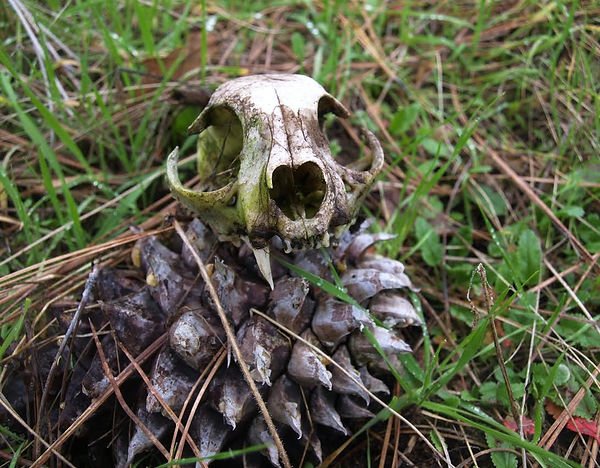
Bobcat Skull on a Pine Cone
Suite No. 14, Seventh Movement:
RETURN TO WARD LAKE
Recently I drove over Kaiser Pass, edging along the treacherous, single-lane road that forces drivers to take turns hugging the cliffside. Feeling adventurous, I ignored the turn-off to Mono Hot Springs and came unexpectedly upon a small lake, no more than a pond really, where tules were flourishing next to the road. Across the lake a rock formation rose like the grandest, most formidable cathedral on earth. The place seemed eerily familiar, so I parked the car and stretched my legs. Suddenly, as I gazed at the lakeshore, I noticed a blue dragonfly, which transported me back to a moment in my childhood forty years ago. Whoever I thought I was fell away, and, just like forty years before, I experienced pure being in a timeless place.
As a child, I usually didn’t associate experiences with specific geographic locations, so I didn't know the name of the lake or its relationship to other places. I’m still surprised when childhood memories unexpectedly flood back to me after I encounter a creek or river or pond that I once haunted for a few hours. My father, in search of a fishing hole, had ended up at Ward Lake early one summer morning, a drive from Fresno of almost three hours. We must have left home during the wee hours because I woke up as he was parking the car not long after sunrise. The first thing I encountered as I was dashing to the shore was a sapphire dragonfly hovering in the tules.
Like all twelve year olds, I had dreams that I was absolutely sure were going to come true. Almost all, of course, have since faded. As I stood gazing at the dark lake as a child and as a man, I wondered uneasily why we choose not to stay and live the remainder of our lives in such timeless places. I concluded as a child that human society must offer something better. As a man, I wasn’t so sure. A place like Ward Lake can put one's society into much greater perspective.
The quiet lake and the huge trees and the massive rocks gave me the uneasy feeling that most of what I think and feel and believe and dream about is just noise, the chatter of the monkey mind, yet I often continue to play the same noisy tune over and over as if the world depends on it. At Ward Lake the tune vanished, and for a moment I felt afraid. I longed to return to a place where I could hear the noise of human society. At that moment, the tree trunk that I was standing on reminded me only of death and chaos. I had a bizarre desire to clean up the humus and the fallen branches, to pull the dead, water-logged trees from the dark water. I sighed as I stared at the awesome rock rising high over the lake, its reflection extending deep into the water. I couldn’t imagine a way of making the rock less intimidating, of making it something that as a human I could dominate and control.
I realized then that I was having an irrational desire to manage an ecosystem that contained its own inherent order. I wanted to recreate the place in a way that seems more like human society, to restart the tune that I understood so well. Yet in the quiet something inside of me said no, let it go, and once again I returned to a state of simply being. I felt complete. It seemed easy, as if all I ever had to do was make a conscious choice to let go of the fear of losing my identity, but I soon suspected that I wouldn’t be able to maintain that feeling for long.
The lake and the massive rocks and trees were imbued with a life that did not need humanity at all, which inexplicably troubled me. I strolled back to the tules where the blue dragonflies hovered and bobbed here and there; I hoped to experience again a sense of wholeness and peace. I remained still, conscious of my breath, consciously letting go of the noise in my head, contemplating otherness, as if I were meditating with my eyes open.
I remembered seeing dragonflies all the time when I was a child, sapphire and ruby red and shimmering green, and it occurred to me that I had not encountered a dragonfly in many years. Suddenly I missed them terribly. Where had they all gone? Were their populations decimated by cultivation and pesticides and urbanization or was I just visiting the wrong places? I felt a profound sense of loss as I gazed at a blue dragonfly hovering nearby. I wanted to snatch it and hold onto it. Then I suddenly remembered that my father had died about five years after our trip to Ward Lake.
Once again a sense of chaos and death and the unknown overwhelmed me. I felt like a Puritan at Plymouth Rock facing the dark forests of an unchartered continent. I wanted to cut down the trees and level the ground and create a safe, comforting, glitzy civilization where suffering and death could be hidden away and ignored. I wanted a city to spring up on the hill.
Yet the sense of timelessness again enveloped me. I felt renewed, like I was a child again, like my father was still fishing somewhere by the lake. I wanted him to remain there in the brilliant sunshine, dwarfed by the magnificent trees and rocks, his shining line deep in the dark pond. Of course, I knew he wasn’t there, but because in my mind there had been no passage of time, I continued to imagine that he was standing by the water, his body a still shadow in the dark water, the lake even more sublime because of it.
I was snapped to reality back by the clock. I had to head home. I shook my head, suddenly feeling queasy, as if my inescapable need for human order was a chronic sickness that always eventually blocks my connection with nature. I wanted to silence the noise in my mind for good and just listen to the quiet lapping of the water and feel the timelessness and the sunshine and the breeze.
At that point I realized that deep in my soul I needed the quietness and the sense of otherness, even if it was occasionally accompanied by the recognition of chaos and death, but I also needed human order, the noisy song of civilization. I needed to strike a satisfying balance, and I hoped that my children wouldn’t lose the rejuvenating sense of pure being and timelessness and otherness that they could find in places like Ward Lake.
We need wild public lands near where we live, such as the San Joaquin River Gorge Special Recreation Management Area, which might soon be buried under hundreds of feet of water if Temperance Flat Dam is approved. We need those places to rejuvenate us and help us maintain our sense of continuity and our connection with all life and with something beyond us--something sublime.

Camel in the Carpet
Suite No. 14, Eighth Movement:
THE CAMEL IN THE CARPET
My father spent much of his adult life gripped by the desire for a better life, so he kept getting slightly better jobs, and we kept moving every few years to a slightly larger tract house. When I was eleven, my family escaped the racial tensions that pervaded Los Angeles after the assassinations of Martin Luther King and Robert Kennedy by relocating to a small town in the San Joaquin Valley. The day after we moved in to our new home in Fresno, I was unpacking boxes on the plush orange carpet of our family room and discovered a zipper bag stuffed with miniature plastic toy figures, soldiers from different wars mixed with exotic people and animals from different continents. All were smaller than the average toy figure, which made me feel godlike as I positioned them on the furniture or the floor in some dramatic scene, such as an ambush or a battle.
That day, when I opened the bag, tempted to play with the toy figures again, I found a tiny camel, pale lemon yellow, which came with a flat plastic stand resembling a puddle of desert sand. As I searched through the bag, I experienced a premonition that the camel would have significance for me in the distant future. Flustered, I searched the new house for someone to talk to about it, knowing that I might not be able to find the right words. I couldn't find my father or mother or grandparents but eventually discovered my brother in the garage.
“You're full of it,” he sneered after I told him. I wanted to explain that I was simply trying to understand a bizarre premonition but then realized that I was once again suffering the fate of a younger sibling, irritating my brother merely by my presence.
Forty-four years later, my brother and I had to sell the house to pay for my mother's long-term nursing home care. While living alone in the house, she had experienced bouts of dizziness but didn't complain about them to anyone. She eventually fell face down on concrete and ended up undergoing a craniotomy for a subdural hematoma with a mid-line shift (in other words, serious bleeding in the brain). After the surgery, she lived with me and my wife for almost two years. Then she fell and broke her hip and spent two months in rehabilitation.
Two weeks after she came back to live with us, she suffered severe stomach flu, which led to dehydration and infection and a serious spike in blood pressure when she attempted to sit up. She could no longer get out of bed, and I, believing that she would recover like she always had before, hesitated to take her again to the emergency room. I soon realized that she needed someone more qualified to care for her. I had, despite my best intentions, made an error in judgment could have led to serious illness or death.
While she was living with me and my wife, her house was, for all intents and purposes, abandoned. I checked on it every other day and did what I could to maintain it, taking care of termites and filing an insurance claim for mold and fungus. I also had to file several insurance claims for burglary and vandalism. Because burglars shattered a window pane in her front door as well as her back sliding glass door, she ended up with new carpet for the front room, family room and hallways, but enough was enough.
When my brother and I were clearing out the house, getting it ready to sell, my brother found the tiny toy camel on a shelf in the garage and smiled as he handed it to me. For a second, I hoped that we would find the sack of other toy figures, but then I recalled, as though suddenly recalling a vivid dream, the baffling premonition that this camel would at some point have significance for me. I don't think that my brother remembered what I had told him, and I didn't want to remind him of it because I knew that I would probably just irritate him like I did forty-four years earlier.
When I pulled the camel out of the bag so many years ago, I foresaw the future. I can recall at least four other times in childhood when this happened to me. In each case, I either heard a voice clearly tell me about the future or felt a premonition—I didn't just suspect or imagine that something was going to happen, in other words—I knew with unshakable certainty. In each case, I only remembered when the event came to pass many years later, as if each premonition were meant to be forgotten and unexpectedly recalled so that I could place the experience in perspective. I doubt that anyone can provide an adequate scientific explanation for these experiences, but I suspect that in the physical dimension, the five senses limit human beings so much that we can only experience linear time, but in some other dimension all time exists at once, and a higher or deeper aspect of the self, a higher self that transcends space and time, can access knowledge about what we in our dimension can only know as the future. If true, this would make the already knotty issue of free will even harder to untangle.
Since I foresaw the future at least five times while I was growing up, I must conclude that these premonitions are more than mere coincidence. These episodes of precognition tie the future and the past together for me in a way that most memories do not, suggesting that I am meant to place the experiences into a larger perspective.
About fifteen years or so ago, I became obsessed with the modern Qabalah after a series of visions during meditation introduced me to the symbol system known as the Tree of Life, and I immediately associated the camel with the Path of Gimel, the thirteenth path on the Tree, which connects Tiphareth, the Christ center, with Kether, the Crown of creation. The Path of Gimel is the central path that moves across the Abyss between the planes of manifestation and the spiritual plane (from which comes intuition). This is the path of the mystic who escapes the wheel of birth and death to live in the spirit. The Hebrew letter Gimel means “camel,” suggesting that something other than intellect or conscious determination is necessary to travel across the Abyss, the way a camel, through sheer primal strength and willpower, crosses a desert.
I stared at the camel for a few seconds, suspecting that some greater significance related to the Path of Gimel would soon unfold. The camel, I realized, was like a symbol in a dream. Coincidentally the Path of Gimel is associated with the moon and dreams. The reappearance of the toy camel suggested to me that sometimes symbols are embedded in mundane events as they unfold in linear time to help us understand their significance the way that symbols are embedded within dreams to help us make sense of waking life.
As I stared at the camel, I realized that I was as old as I had imagined I would be when I was a boy and had foreseen the future--my beard gray and my head bald, but I felt pretty much the same as I always have. Most of the people in the neighborhood had died or moved away while the camel had waited alone on that shelf. My mother was eighty-nine years old and getting frailer even as we emptied her house, but she seemed pretty much the same as she had always been when I was a child. At that moment, I believed that people feel pretty much the same their whole life, which comforted me, but I was saddened by the inexorable black hole, never visible but always near, that kept sucking everything, including my other toys, into it.
And at that moment, in the house that I had not lived in for thirty-seven years, the only thing that held much significance for me was the toy camel, as if the rest of my childhood was irrevocably lost due to a lack of anything tangible that I could touch, but oddly, at that moment, I was happy. I couldn't quite put my finger on it, but I sensed that the camel confirmed everything I had secretly believed.
I placed the toy camel on the dashboard of my car, and in the Valley heat three of the brittle plastic legs broke off one by one, leaving little stubs. If I were to speculate about the symbolic significance of the one-legged camel, I would interpret it to mean that on the spiritual journey across the Abyss, legs don't matter, only the spiritual will to continue, against great challenges, on the journey.
It took me a few days to figure out why at that moment I was happy, but I wasn't always in an upbeat frame of mind during that time. I felt that I was slowly emptying all memories of my family from the house as items departed to the dumpster or storage or the Salvation Army. My grandparents and my uncle, my father and mother, and my brother and I had comprised the whole of the family that settled in Fresno in 1971. By the mid seventies, my grandparents had both passed away. Then, in 1977, three days before his fifty-sixth birthday, my father died of a heart attack. I moved out when I was eighteen after my brother had moved to a different state. My mother remained alone in the house. My brother and I became busy with college and jobs and families of our own and didn't stay in touch, and I didn't see my mother very often even though I lived down the street. By the time my uncle died in the early 1980s, what was once a family unit felt more like a mirage.
After a week of helping me clear out the house, my brother and his wife had to return home to resume their daily lives. During the process of dealing with my mother's house and belongings after they left, I dropped her car off at the repair shop and took a shuttle bus home. I asked the driver to let me off at a corner so I could stroll through my old neighborhood, past the house near my mother's that I had rented for twelve years.
Strolling by my neighbor's house, I remembered that several of my cats had disappeared. One cat showed up after a few days and came tearing through the house with a pellet from a gun lodged in his throat. While my son and I were playing electric guitars one day, our neighbor, uninvited, barged into the house, dashed to the back bedroom and started screaming at us. A few weeks later, his sister told us that he had died alone, his body discovered several days later surrounded by cages, in which, I suspect, he had imprisoned neighborhood cats and tortured and murdered them.
I ambled by the house of my daughter's friend, Jenny. At one point when Jenny had just turned eighteen, the police found her in suspicious circumstances. She had somehow suffered damage to her frontal lobe (which would make it difficult for her to function the rest of her life). She woke up handcuffed to a bed in a hospital and could not remember what had happened—the police initially believed that she had stolen a truck, only to discover that the man who owned the truck had drugged her and kidnapped her. A few years earlier, Jenny's brother had also suffered a similar type of brain damage in an automobile accident and had fallen victim to a child molester.
Steve Watson had lived across the street for awhile. I was a year older that Steve. He had been in my fourth-fifth combination class when I first moved to Fresno. We were also on the same little league team during middle school, at a time when I was losing all interest in sports. He had turned into an amazing athlete who could throw the most mind-boggling pitches, one of which, I remember, always wove unpredictably past my bat. He ended up in the minor leagues on his way to a career in professional baseball, but health issues interfered. I had just recently encountered Steve on a gurney in the hospital around the corner from my mother during her bout with the stomach flu. He had driven a bright red corvette when he had lived across the street from me, but in the hospital he was shaggy and dirty as though he had been living on the street for quite some time. As I passed him on my way out of the hospital, he asked if I remembered him. Oddly, his name popped out of my mouth even though his face was unrecognizable under long gray hair and a beard, and we had a short chat, during which he informed me that he had lost everything due to his chronic illness.
I past the house of a portly man whom my wife and I had called “The Mayor.” He had retired many years before and often stood in his garage monitoring the neighborhood. Once he nailed yellow ribbons to all of the liquid amber trees on the public easements along the street in support of the troops in the Persian Gulf. He died soon after we moved away, and the neighborhood felt a little less safe.
Many of the people of my parent's generation who had lived in that neighborhood had also died, and I recalled their names as I strolled by their houses.
Two houses down from my mother's house a shy girl named Shayla had grown up. After her father died and her mother was moved to the memory care unit of a nursing home, Shayla continued living in her parent's house. Shayla once had a crush on my brother, someone had told me, and I had spread the rumor throughout the neighborhood. She later raised two children in that house and died in her early forties from breast cancer. I had no idea where my other neighborhood friends were now.
When I reached my mother's house, I felt alone. Each of the people in the neighborhood who had passed away, I mused, had lived a short while to clothe their dreams in matter. When I stepped into the house, I pulled two heavy key chains out of my pocket, and the toy camel fell out of my pocket onto the carpet. The camel could only have great significance for me now: As a child I could not possibly have known such a heightened sense of impermanence. I should just let go, I muttered, as I gazed mournfully at the camel, just release and let go. Strangely I did not need to try: I felt no desire at all to keep the camel or anything else that had once graced the house.
As I entered my mother's empty kitchen, I remembered my first day of school after our first night in Fresno. Early in the morning, my mother took my brother to sign him up at middle school and left me alone for at least a half an hour before she came back and drove me to my new elementary school. When they left, I was free, I realized; I had never been left alone in a house before. However, strange noises terrified me. Forty-four years later, I felt almost the same, aware that I am free, not lonely but essentially alone, aware of all the pops and creaks in the house but not afraid. I had the strange feeling that I was eleven again even though at the time I was exactly the same age my father was when he died of a heart attack.
Her empty house made me unexpectedly happy because I felt free of anyone else's expectations. All of the relatives who had gathered with us over the years were gone or had lost touch. My eighty-nine year old mother now barely remembered any of those gatherings so important to my father, who had spent his life getting a better job every few years and buying a better house and a bigger car, finally settling in a neighborhood at the northern edge of Fresno, CA, not far from one of the first malls in the Central Valley. Soon all the fields and orchards north of Shaw Ave would be plowed under; the northern edge of town now is miles away, bordering the San Joaquin River. A town of one hundred thousand has grown to half a million since my father passed away four decades ago.
The camel in the carpet, even more diminutive after the loss of its legs, was so small that I hardly noticed it as I surveyed the empty room even though I knew where it was. It would no doubt be overlooked by most of the people who came to view the house if I left it there. The camel, alone in a vast desert of brown carpet, was free.
For many years, I lived my life as others expected, afraid that losing all sense of social conditioning through rebelliousness or cognitive dissonance or separation from the herd or trauma might lead to insanity or worse. I know several people who crossed that invisible line at some point in their lives; they kept up appearances while secretly plotting and carrying out heinous acts. It struck me as I stood in the empty room, remembering the time that I was eleven, that I have always had the spirit of the camel in me. I have had enough premonitions and intuitions to develop faith and enough challenges to understand the value of it. I have never been a great success at anything, but I at least developed a love of nature and the arts, experiencing an exultation of consciousness that has led to the Vision of Harmony, associated in the Qabalah with the state of being known as Tiphareth, which instilled in me a sympathy for all things, a connection that some people would no doubt cause some people to question my sanity.
The camel in the carpet was signifying to me now that I could proceed on the Path of Gimel. As I stared at the camel, I knew that I had recently crossed a line and couldn't turn back. The Path of Gimel leads from Tiphareth across the Abyss to the first swirlings of the Source, the Crown of Creation. I knew that I had to travel across the Abyss alone, with only my sense of adventure and exaltation and connection with divinity to goad me on.
Instead of the dinner table under the small chandelier, where I had gathered so many times with aunts and uncles and grandparents and cousins and friends, there was only a tiny one-legged camel in the sand-colored carpet. I imagined it plodding away on a journey into the unknown, drawn only by a powerful desire. All desire to remove myself from divinity for the sake of appearances or to expend all my energy accumulating the stuff of the tribe had vanished, as though blown away by desert winds. I softly shut my mother's front door, and with only a faint moon path to guide me, stepped into my next adventure.

Pestle next to a Pounding Stone
Suite No. 14, Ninth Movement:
TRAILBLAZING
Just after I became a teenager, I spent about a year in the boy scouts. I got kicked out of the troop before I earned Tenderfoot. I wasn’t sorry about getting kicked out. Forty years later, I realize that I learned a lot about the archetype of the God Mars from the experience.
At a scout meeting we found out that we were going to Millerton Lake for a weekend of “trailblazing” so that we could all earn a merit badge. I soon forgot about it until one Saturday my Dad dragged my brother and me out of bed at sunrise to get ready for the trip. The neighborhood boys in the troop carpooled with us, and we tried to sleep during the ride to the lake, but we were all jolted back to reality after thirty minutes or so: After we arrived, we were ordered to set up camp immediately. Then we piled into a different car and headed out to the east side of the lake, where we discovered that every boy scout troop in Fresno was “trailblazing,” in other words, making a fire break--which sort of resembled a wide trail--around the edge of Millerton Lake.
After digging and shoveling and raking for two hours in the hot sun, the gang of scouts from my neighborhood plopped down on the ground and entertained the idea of deserting the trailblazing efforts and heading back to camp on foot, a hike of at least five miles through unknown terrain.
A scout master sauntered over and yelled, "Get back to work, right now!" After he ambled away, Alan threw down his shovel and delared, “Man, this is nothing but slave labor!” Alan, wild and fearless, had emerged as our ring leader after his father had died of leukemia a year before. The neighborhood gang followed Alan wherever he went.
So we all threw down our shovels and took off down the hill without food or water--and without telling the scout master. We hiked along the edge of the lake, discovering that the way back was more challenging than we had anticipated. We struggled through dense riparian forest and maneuvered around large rocks on steep inclines and kept plodding along the edge of the lake, with no end in sight. Nevertheless, we managed to blaze a trail all the way back to camp--dead tired, starving and dying of thirst by the time we got there.
None of the adults ever confronted us about going AWOL, I suspect because of worse things we did that weekend. I was two years younger than all of them, so I was never too worried. We rested until the other troops returned to camp. Then Alan quickly came up with another plan. He and another scout were going to arm wrestle in the parking lot near the boat launch while we stood around them yelling, “Fight! Fight!”
After the two of them got on their stomachs, facing each other, I started shouting. Soon a raucus crowd of scouts gathered around the pair. I quietly inched away as a scout master rushed to break it up. A minute later, the scout master stormed back to camp, all flustered and disappointed. Alan and the other boy were laughing uncontrollably as the crowd dispersed.
That night, just as I was about to dive into my sleeping bag, Alan excitedly told us that he had a big surprise for us. Holding the only flashlight, Alan took off at a brisk pace in front of us, and the gang did its best to keep up. I remember wondering why we were wandering around in the dark when suddenly we reached the camp of another scout troop.
“This is a raid, boys!” He smiled.
“Okay, what does that mean?” I asked, already exhausted from a long day.
“I mean jump on the tents and beat the crap out of them!” Alan commanded, pointing at a nearby tent.
So I jumped on the tent, which immediately collapsed, and then started wailing with my fists on whatever and whoever was inside. I hit something over and over, but there was no response, either because the boys inside were petrified or because I was only pounding on backpacks. I opened the flap of the tent but couldn’t see anything. I didn’t want to see anything.
Suddenly Alan shouted, “Let’s go!”
Once again, we followed Alan in the dark, ending up in tall grass under an oak tree.
“Here, hold this,” he demanded, handing me the flashlight. He was grasping something else in his hands. He yelled across what seemed a vast abyss, “Hey, we’re over here. Troop 88 just kicked your ass! Troop 88! Over here! Come get us! Come and fight, you pussies!” Suddenly, Alan turned to us and quietly commanded, “Get down.”
We crouched in the grass as Alan started swinging something above his head. I aimed the light at the branches in the tree and saw something flashing intermittently above us. Before I could figure out what it was, I heard footsteps rapidly approaching.
“It’s a chain,” I muttered to myself, as ghostly forms entered the circle of light. Then I found myself shouting, “It’s a chain. It’ a chain!”’
The other troop stopped abruptly, hovering at the edge of the light.
“Turn the light off,” Alan demanded. “Let’s get out of here!”
As I fumbled with the flashlight, Alan and the others vanished into the darkness. I dashed after them, following as well as I could their track in the grass. Soon I lost them, but I didn’t dare turn on the flashlight.
I had been ditched before at night, once even in a pitch black cave after Alan had switched off the flashlight, but this time they had left me alone to fight off an entire scout troop. I turned around, surprised that the other troop was not yet descending upon me.
In the moonless darkness, I had no idea where I was, but I glimpsed some lights in the distance and headed towards them, hoping they weren’t the lights of the rival troop. Somehow I managed, to my great surprise, to blaze a trail back to the right camp.
I found Alan and my brother in their sleeping bags, gazing at girlie magazines in candlelight. The candle stood erect on a flat disk. I was so exhausted by then that I didn’t say anything. I didn’t even ask for a magazine. I just crawled into my sleeping bag and fell asleep.
I awoke to someone yelling, “Fire!” One side of the pup tent, I discovered, had caught on fire, and I threw myself out of the tent. Suddenly my head hurt, the pain excruciating. I stood by dumbfounded as Alan and my brother beat the fire out with some clothing from my backpack.
“My head hurts!” I yelled.
“Just shut up and go back to sleep,” my brother demanded.
“What happened?” I asked, knowing how much Alan loved to play with matches.
“The candle was set on a flare.”
“That flat disk was a flare?”
“Yeah, and the candle burned all the way down. Now go to sleep. And don’t tell anyone!” We crawled back into the tent, which now had a large, smoking hole in the side, and I tried to sleep despite the smoke and the excruciating pain and an unfamiliar, sickening smell.
The next day the older boys looked at my hair after I told them that my head hurt and they all said no, nothing's wrong. One of them got out a brush and told me that I had rats in my hair, the boy with the brush pulling out a few clumps and quickly hiding them, saying no, no, nothing's wrong.
My parents noticed immediately upon our return that the hair on the back of my head had been burned away, the skin black and red and shriveled up.
Within a week, my brother and I and Alan were kicked out of the boy scout troop. I’m not sure if it was for dereliction of duty, for staging a "pretend" fight, for the raid, for the fire, or for just plain orneriness.
The Tower: Mars, Path27
In retrospect, I realize that these experiences did more than “build character.” They gave me a better perspective on a rather disconcerting Tarot card called, “The Tower,” which is associated with Mars and the element of Fire.
Especially in the past hundred years or so, many individuals and societies have experienced the influence of the Mars archetype. The virtues of Mars include great energy, courage, strength, potency, and the appropriate use of power. The vices of Mars include cruelty and destructiveness. Arguably in the past hundred years we have seen far too much of the latter as we collectively and individually learn how to handle the forces of the God.
In everything he did, it seemed, my friend Alan embodied the archetype of Mars, for good or ill. He demanded loyalty in all of his battles against the world, no matter how crazy, cruel or destructive, and eventually I simply tired of what seemed like the senselessness of it all--but all along we, thanks to him, were learning the positive and negative aspects of the archetype (usually the negative).
On the Tree of Life, Mars is primarily associated with the fifth sphere, or sephira, known as Geburah, or “Severity.” The sphere is referenced at the end of the Lord’s Prayer as “the Power” and corresponds to the right shoulder in the individual. The God Mars personifies the forces of the fifth Emanation on the Tree as well as the connecting path between the seventh and eighth spheres, a path symbolically represented by the trump card “The Tower.” Mars is also associated with number cards that reveal different facets of the archetype.
Seven of Wands: Lord of Valor
Decan: Mars in 21 - 30 degrees of Leo
Tree of Life Association: Venus in Netzach (Seventh Emanation)
When people like Alan experience the energies of the sphere of Geburah, they open the potential to become strong, charismatic leaders if they do not become unbalanced by the forces. If unbalanced, they can become leaders who cruelly exploit and harm people.
Only now, it seems, after a century of war on a scale that humanity has never known before, are we beginning to see the positive aspects of the forces of Mars. Mars burns away false, limiting, destructive patterns and beliefs so that the truth can be known, justice can be served, order and harmony can be maintained, and the light of higher awareness can be revealed. Mars cuts away whatever is diseased and purifies the self, eliminating what is no longer useful. Mars establishes and maintains order with an authoritarian hand and harnesses powerful forces so the forces can be used productively, the way an engine or a body uses fuel. Mars, potent with the life-force on all levels of being, is married to Venus, Goddess of love and beauty--which says a great deal about the ability to know and appreciate both love and beauty. Mars, the ultimate warrior, is awe-inspiring, even terrifying--not a God to trifle with.
Unfortunately many see Mars the ultimate warrior and want to use the power of the archetype to assert dominance over others for selfish, ego-driven reasons. Even though this is a common use of the power of Mars, so common that it might even be considered by many the appropriate use, it should not be treated as an ideal use of power but as an unbalanced aspect of the force of Mars, the “vice” that leads to cruelty and destruction. Mars works for the highest good, not for the ego, and is on the side of the underdog striving for justice.


Pounding Stone on a Ridge
Suite No. 14, Tenth Movement:
THE DIVINE FEMININE VERSUS PATRIARCHAL CAPITALISM
Once, I had a vision that I was strolling in a soft-blue monk's robe on a stone path through an enclosed garden. From a distance I could see a stone statue. As I approached, I saw a statue of Jesus on the cross and knelt down, but when I looked up, to my surprise, the statue had transformed into the Virgin Mary.
This vision occurred while some friends and I were “chakra toning,” a New Age technique for opening the energy centers of the aura, which consists of singing the note associated with each primary chakra one at a time for an extended period without stopping. In theory, this technique links the mind with the associated spiritual vibrations of the primary chakras. The toning session begins with the note corresponding to the root chakra and proceeds up the scale without interruption to the highest chakra. By the sixth note, after singing nonstop for about thirty minutes, I had achieved an altered state of consciousness through hyperventilation.
I was surprised by the vision for several reasons. First of all, I have never worshiped Christian icons, and before then I had mainly experienced visions of symbols associated with the Tree of Life, the sacred glyph of the mystical Qabalah. Even more surprising to me, in the vision I was a monk in a monastery garden. I had entertained the idea of becoming a pagan priest but never a Christian monk. Moreover, I was wearing a hooded robe of the purist soft blue, which both intrigued and confused me, because I thought that monks only wore black or brown or white robes. Before then, I had never imagined kneeling or humbling myself before the Virgin Mary or any other feminine deity, an act which I interpreted as a show of willingness to sacrifice myself in some way. The very act of becoming a monk, of course, requires sacrificing a worldly life for a spiritual one. Donning the robes proclaims detachment from the ornaments and distractions of the world.
I told my friends about the vision but soon forgot about it since the symbolism seemed boringly conventional. At the time, I did not know enough about the complex symbolism of the Tree of Life in the Western esoteric spiritual tradition. Finally, after many spiritual experiences and over ten years of study, the meaning of the vision, which is more Qabalistic than I had initially imagined, has grown much clearer.
Without realizing it, for most of my life, I have manifested the archetypal energies of the divine feminine, in other words, the Goddess, no matter the circumstances. In the vision, I was worshiping the celestial Goddess, the feminine principle of creation, revealing my devotion to Her. Though strange, the vision seemed appropriate to me because of my devotion to the arts and the natural world from childhood on, but the vision revealed a deeper level of meaning that can only be understood in the context of the Tree of Life.
There is an old saying in the Mysteries: “All the Gods are one God, and all the Goddesses are one Goddess, and there is but one true initiator.” In terms of the Tree of Life, that means that the feminine principle shows up as different Goddesses on different levels, or “paths.”
The Tree of Life reveals the evolution of the cosmos from the finest spiritual energy to the densest physical manifestation through ten primary Emanations of being known as Sephiroth (plural). Each Sephira (singular) within the cosmos emerged from the previous state of being and eventually emanated the next. The first three Emanations contain the basic principles of creation, for instance the duality of the masculine and feminine states and the existence of unity within multiplicity, but remain above the Abyss, outside of manifestation. The Virgin Mary is symbolically associated with the third Emanation, a supernal Sephira on the Tree of Life known a Binah, or Understanding.
The celestial Virgin, the archetypal feminine principle above manifestation, therefore experiences immaculate conception, and gives birth to a savior God, the “Son” of the Trinity. Binah, the sphere of the celestial Virgin, is the primal womb of manifestation from which all form originates, hence its association with Saturn, with stone, and with the sea. The third Sephira, though outside creation, ushers in the lord of all terrors. The word Mary comes from the Hebrew word marah, “bitter” or “bitterness.” Binah, the great sea of evolving life, is bitter: Whatever is born must die.
The feminine principle, as I mentioned, is associated with other Goddesses on different paths on the Tree, most notably with Netzach, the seventh Sephira ruled by Venus—the sphere of nature, beauty and the arts. I was born under the sign of Aquarius, which on the Tree links the Sephira of Yesod with the Sephira of Netzach, each of which emphasizes different aspects of the divine feminine. In my vision, though, I was worshiping the celestial Goddess. I had already manifested the energy of Venus through my art and adored Demeter through my love of nature. I had found the energy of Luna through meditation and had connected with Ma'at through my efforts for truth and justice. In terms of the Tree of Life, the vision made perfect sense: I have sacrificed my personality to manifest the energies of the Goddess on different levels.
Several connecting paths on the Tree of Life, including the Path of Gimel, the Path of Daleth, the Path of Teth, the Path of Lamed, and the Path of Tau, also reflect aspects of the Goddess, so the adventurer on the Tree of Life has the opportunity to meet the Goddess at many points on the spiritual journey. In the archetypal hero's journey, the meeting with the Goddess represents a stage in the adventure when a person experiences a relationship that has the power and significance of an all-encompassing, unconditional love. Also known as the sacred marriage, the union of opposites, the “meeting” may take place on a purely psychological level, representing the unification of the self during which the hero begins to see himself in harmony with all of creation.
A psychic, about a year before my vision, told me that my aura is soft blue, which may partially explain why in the vision the monk's robe is blue. Renditions of Mary portray the Queen of Heaven and Earth and the Great Sea also in blue. My monk's garb in the vision is, on one level, an emblem of my adoration for the Goddess. Soft blue is also a symbol of the spiritual level in Chokmah, the Emanation of dynamic, masculine energy opposite Binah, which connects the primarily masculine energy of the celestial God with the energy of the celestial Goddess.
According to Dion Fortune, an authority on the modern Qabalah, the bible, which is essentially a Qabalistic book, contains God-names that pertain to the different Sephiroth on the Tree of Life. For instance, all references to the Father concern the second Sephira known as Chokmah, or Wisdom; all references to the Son apply to Tiphareth, the Christ-center; and all references to the Holy Ghost, the feminine principle within the trinity, relate to Yesod, the Foundation, from which the physical universe has evolved. The Holy Ghost attracts archetypal spiritual forces like a magnet to the Kingdom, the physical world. The dance of the Gods, feminine and masculine, is the dance of the archetypal energies of one God through different dimensions of the cosmos, energies which ultimately manifest in the material world.
The paths of the Goddess bring peace and harmony and a feeling of oneness with all creation. Only after I started meditating and envisioning spiritual symbols did I realize that the feminine force goes by different names, Mother Earth, World Soul, Holy Spirit, Goddess, and that one aim of occult spirituality is to contact this great force and experience its powerful influence—and through its influence other awesome forces that in Christianity go by the name of the Son and Father of the trinity.
Recently I experienced an epiphany about why, during an extended period of meditation, I had a vision of a golden, equal-armed cross. In the vision, the golden cross floated in a deep, blue sky, and at each end of the cross an angel hovered, each angel in a colored robe, one yellow, one red, one blue and one white. This was the second in a series of visions of archetypal symbols, all of which, I eventually discovered, are associated with the Tree of Life, the great composite symbol of the mystical Qabalah. As I mentioned, the visions came as a total surprise: Before I began meditating at the age of forty-two, I was oblivious to spiritual symbolism in general, so the full meaning of the symbols has often taken me years to understand.
According to Dion Fortune, under Yesod is Malkuth, the Kingdom, where the energies of the Tree manifest (179). Kether is a state of pure spiritual energy, Tiphareth a point of transition or transmutation between the planes of form and formlessness, and Yesod a subtle plane of form directly “above” the physical plane.
Even though I was unaware of it at the time, the vision of the equal-armed cross and the angels revealed the basic structure for rituals that involve the spiritual energies of the Holy Ghost and the four archangels representing the elements that form the background energies of manifestation, the basic structure, in other words, of the banishing and invoking rituals used by occult lodges. Since her book is so dense that at first it seems written in code, it has taken me years to unpack the meaning of Fortune's Mystical Qabalah. In what first seemed to me merely a passing remark, Fortune mentions that the occult lodges worship the Holy Ghost, associated with Yesod, the Foundation from which the physical universe emanated (179). In a previous section, Fortune reveals that the Holy Ghost is the feminine aspect of the trinity (47).
These two key points have profound implications for Christianity and society as a whole. One of the goals of personal mysticism is communication with the Holy Guardian Angel, or higher self, the Individuality that develops through an evolution (also known as the soul), which is connected to the divine core of being and transcends space and time. The mystic, as Fortune points out, begins in the humble manger, not on the Mount, so the first communications from the higher self come through Yesod, the state of being associated with the Holy Ghost and the feminine principle of creation--in visions of archetypal symbols and voices. The composite symbol of the Tree of Life itself, which represents the unseen forces in the collective consciousness of humanity, is a gift from Yesod, the subtle realm of symbolic form.
Higher psychism is the domain of the Son, Tiphareth, the Christ center: The subconscious mind, in other words, first accesses spiritual principle through archetypes and symbols in Yesod, the subtle plane of form above the physical plane. Tiphareth, the Christ center, is the Sephira of the Sun, of blinding illumination, where form dissolves in light. Only after shaking free from the physical plane and making initial contact with Yesod, first experiencing spiritual principles through visions of symbols, can the mind begin to make sense of illuminations from the higher planes. The mind slowly builds, piece by piece, a temple of symbols representing spiritual principle, which makes comprehensible the experiences of illumination and exultation that swing the mind beyond Yesod into the blinding sphere of the Son, Tiphareth-- the center of cosmic equilibrium, harmonizing love and spiritual inebriation.
According to Fortune,
Illumination consists in the introduction of the mind to a higher mode of consciousness than that which is built up out of sensory experience....Unless, however the new mode of consciousness is connected up with the old and translated into terms of finite thought, it remains as a flash of light so brilliant that it blinds. We do not see by means of the ray of light that shines upon us, but by means of the amount of that ray which is reflected from objects of our own dimension upon which it lights. Unless there are ideas in our minds which are illuminated by this higher mode of consciousness, our minds are merely overwhelmed, and the darkness is more intense to our eyes after that blinding experience of a high mode of consciousness than it was before. In fact, we do not so much change gear as throw the engine of our mind out of gear altogether. This, for the most part, is what so-called illumination amounts to. There is enough of a flash to convince us of the reality of superphysical existence, but not enough to teach us anything of its nature. (180)
Before I knew the Tree of Life even existed, I had during meditation envisioned many of its symbols. Eventually I realized that these symbols have enabled me to translate spiritual principle into “terms of finite thought” so that illumination would not merely blind me. The symbols revealed not only spiritual principle, but, in one instance at least, the basic structure of practical magic that connects the practitioner with powerful unseen forces, such as the Holy Ghost and the Son of the trinity as well as Gods and Goddesses and Saviors created by the human mind to represent unseen subtle forces throughout the ages. Contemplation of the paths of the Tarot on the Tree of Life and of the symbolic representations of the Gods is an effective way of translating spiritual experience into comprehensible ideas.
The Annunciation, on one level, symbolically suggests this process. The Annunciation is the announcement by the Archangel Gabriel to the Virgin Mary that she would conceive the Son of God. Gabriel told Mary to name her son Yeheshua, meaning "YHWH is salvation.” The Archangel Gabriel in the Qabalah is assigned to Yesod, the sphere of the Holy Spirit: Through the feminine principle, the first conception of the Son—the recognition of the higher self—occurs. The higher self links up with the macrocosm, the cosmic consciousness of the Father. In fact, the God name of Tiphareth is “Eloah va Daath,” which can be translated as “God manifested in the mind.” The divine feminine principle, the Holy Ghost, elevates the mind beyond the physical into the superphysical, into this greater illumination.
As Fortune points out, through the type of consciousness associated with Yesod, “mystical experience gradually builds up a body of images and ideas that are lit up and made visible when illuminations take place” (180). In order to build this temple of images, symbols, and ideas illuminated by higher modes of consciousness, the mind must be open to spiritual influences, which requires a passivity and a receptiveness of the mind associated with the feminine Holy Ghost and Yesod, the sphere of psychism. One must go deep into the subconscious mind, below worries and desires and fears and frustrations, to experience these astral treasures with the senses of the soul. Spiritual development, instead of just being a series of magnesium flashes of illumination and exultation, is a gradual expansion of the mind, a process that is mapped out by the Tree of Life.
Before I began having visions, I was a materialist, believing that only the physical universe exists. To understand my visions, however, I was forced to expand my idea of the cosmos. I had also experienced accurate premonitions and intuitions which revealed that some part of my consciousness transcends my brain and physical senses, but I had simply forgotten or dismissed them—until I had the visions. When I began piecing the moments of illumination together, I discovered that it is helpful to think of the cosmos as consisting of many types of energy in one vast fabric, from the finest spiritual vibrations to the grossest physical matter, and that as an extension of the cosmos, my being also contains those energies, hence the paranormal experiences of nonlocal consciousness that have occasionally surprised me over the years. At the “higher” end of the pole, the energies are formless, evolving into planes of form, the physical universe being the plane of densest matter. We experience “nonphysical” or subtle planes of form in the imagination when we dream at night or daydream or have visions of symbols. When we simply know something is true through intuition, consciousness is operating on a higher, formless plane, rising from Tiphareth, the sphere of the Son to the sphere of the Father.
Immersing myself in nature, the realm of the Goddess known as Mother Earth, is one way that I began to open myself to the Holy Spirit and the illuminations of higher consciousness, at first unknowingly, then intentionally. The beta mode of consciousness, the dominant mental state in this highly competitive society, allows intense focus on the external world but blocks access to unseen spiritual influences, which is why for me at least there will always tend to be a basic conflict between the driving forces of capitalism and and the subtle forces of the spiritual world, why, in fact, I lived so long in a desert. The affairs of business channel the mind away from spiritual frequencies. In a predominantly masculine, patriarchal, capitalistic culture, a barrier remains: Attaining Christ consciousness requires receptiveness and a fair amount of passivity, both qualities associated with the feminine.
Dion Fortune states that a religion without the Goddess is halfway to atheism: In the Qabalah, the masculine and the feminine as well as the physical and the spiritual are polarities that allow the One to manifest as the Many. To vilify, exploit, or misuse the physical or the feminine is to blaspheme the Source of all creation. By demonizing feminine, passive, receptive states of the mind, patriarchal religions and societies block access to the Holy Ghost, thereby effectively establishing a barrier to the other forces of the trinity. One can experience the illuminations of the Son, the Christ force, but cannot fully understand them without experiencing the feminine state of the Holy Ghost in Yesod—and, let us remember, the Son shows us the Father. Perhaps that is why so many Christians love the Virgin Mary and Saint Francis of Assisi, the great soul who loved all creatures, who empathized so much with the Christ and the suffering of humanity that he experienced the stigmata.
One of the places where I have often experienced the Holy Spirit is the San Joaquin River Gorge, an ecosystem that might soon be utterly destroyed by a dam at Temperance Flat. In an example of an economic development described by Naomi Klein as “disaster capitalism,” which results in a redistribution of wealth from the public sphere into private hands (2), farmers in the San Joaquin Valley are using the drought as a way to “take” public lands for private benefit even though a large percentage of the water created by a new reservoir will go to water-guzzling crops such as almonds and grapes and cotton in a semi-arid region (the biggest crop in the San Joaquin Valley is almonds, and each almond takes over a gallon of water to produce), as well as to commodity crops and fodder crops that have no business being grown in a desert. For ensconced private interests, a dam will save the economy because those with wealth, land, and the means of production will have the opportunity to continue business as usual. If the dam is approved, the private interests who benefit will not be required to replace unique and stunningly beautiful public land with another public park or to compensate the public in any meaningful way for the loss of land, nor will those private interests be forced to modify their unsustainable practices (3).
The bottom line of capitalism prevails. Based on my experience in the political realm, I've discovered that the public's opportunity to connect with the spiritual forces within nature is rarely, if ever (I am tempted to say “never”), a concern to those with power and money or to the politicians they influence. Approval of the dam would simply be one more example of how capitalism effectively blocks connection between the average person and the Holy Spirit, and by extension with the Son and the Father, revealing a basic conflict between Christianity and capitalism.
To say that in patriarchal societies the feminine gets a bad rap is understating the case. The feminine brings forth physical life, and since whatever is born must die, the feminine also ushers in the King of Terrors. Physical life is corruptible, always subject to the vagaries of time and the infirmities of sickness and old age. But to the Qabalist, “the natural is but the dense aspect of the spiritual”(194), the outer robe of concealment that covers the inner robe of glory. All life, including plants and insects and reptiles and animals, is spirit manifested in matter. Everything dies but rises through regeneration. Spiritual beings exist everywhere around us in physical forms that sometimes ravish us, sometimes please us, sometimes repulse us, sometimes terrify us. The false dichotomy that presents physical energy as impure and spiritual energy as pure suggests that at the heart of patriarchy is the fear of the subtle emotional, sexual, psychic and spiritual power of women, a fear that has manifested throughout the centuries as witch hunts and as an emotional disconnect from the Holy Ghost.
In the Tarot, the equal-armed cross, which “is called by initiates the Cross of Nature, and represents power in equilibrium” (197), is included in cards that represent aspects of the Holy Spirit: Judgement, the Ace of Cups, and The Priestess. In the Tarot, color has great symbolic significance. In the Ace of Cups the cross is black, in Judgement red, in The Priestess white. In the symbol system of the Tree of Life, the black equal-armed cross is associated with Malkuth, the Kingdom, or physical universe; the red in Judgement symbolizes compassion, which is linked through the Archangel Gabriel to Yesod, the etheric plane; the white in The Priestess is associated with the spiritual laws of the supernal Sepheroth above the abyss. The gold equal-armed cross, which appeared in my vision but does not appear in the Tarot, is symbolically associated with Tiphareth, since gold, representing the incorruptibility of the spirit, is the color assigned to the Christ-center. Through my visions, the golden equal-armed cross links the Son with the Holy Spirit.
In the Tarot card Judgement, the Archangel Gabriel, who is associated with Yesod and the Holy Ghost, blows a trumpet to awaken souls in their tombs, and the souls arise in gray, etheric bodies. These souls heed the trumpet call with psychic senses, not physical senses, and rise in exaltation. As in the other two Tarot cards representing Archangels, Temperance and The Lovers, on one level the Archangel represents a higher mode of consciousness linked with the daimon, or higher self. In Judgement, the Archangel Gabriel also suggests the individual's first encounter with the Holy Ghost and the superphysical nature of the psyche, which leads to a reassessment of the nature of existence.
In the symbol of Venus, the circle on top of an equal-armed cross reveals the perfection of the spirit above the elements in equilibrium. In the Ace of Cups, on the other hand, the equal-armed cross within a circle is being carried by the dove into the cup of manifestation: The Holy Spirit brings the black, equal-armed cross within a pure, white circle to the realms of form where the spiritual and the physical coalesce. In this way also, the Holy Spirit conceives the higher self in the planes of form, resulting in the integration of the psyche.
In the Tarot card The Priestess, the soul is confronted by the feminine principle on a higher arc on a path across the Abyss between the planes of form and the supernal planes of formlessness. Here the equal-armed cross is white, representing unity, in opposition to the black cross of Malkuth, the Kingdom, the white cross suggesting a pure, spiritual logic different from the logic of the physical world, which suggests that the logic resulting in harmony within higher modes of consciousness is also very different from the logic of brain consciousness and the lower personality dealing with the exigencies of physical existence. The higher self can bring the soul into balance in a way that the lower personality doesn't expect or even understand at first. As in Tarot card The Lovers, the masculine aspect of the psyche looks to the receptive feminine aspect in order to know the higher self, which is very different from the belief systems of societies with long, embedded attitudes of patriarchy.
Several times recently during invoking rituals, I have experienced a vision of the jewel in the lotus, representing the spiritual energy of the Father in the crown chakra, coming down the planes through my primary chakras to the earth. The vision emphasizes for me that one of the most important spiritual practices of our time brings spiritual energy into the mind and manifests it in the world here and now. These visions stem from my vision of the golden, equal armed cross related to the Holy Ghost and the elements in equilibrium, and I am living proof that, with an openness to the feminine aspects of the psyche and the cosmos, and with a little knowledge and effort, the average person can bring powerfully transformative spiritual energies into his or her sphere of influence.
(1) Fortune, Dion. The Mystical Qabalah. London: Society of Inner Light, 1998.
(2) http://www.naomiklein.org/shock-doctrine
(3) http://www.cheatsheet.com/business/3-disheartening-truths-about-americas-commodity-crops.html/?a=viewall

Bush Lupine and Oaks near the Kings River
Suite No. 14, Eleventh Movement:
THE JUDGE
At the confluence of two rivers, an oak tree towers over a one-lane road. Over a decade ago, I stood transfixed for ten minutes as an oriole trilled at me, trying to draw me away from its nest. Today, as I stare up into its canopy, I remember that its branches soared above me forty-five years ago when my father first brought my family, including my grandparents and uncle, to the confluence. We had parked by the road to search for a fishing hole, encountering bush lupine in bloom and a tranquil pool that suddenly swept around a curve to merge with the Kings River. That day forty-five years ago as I stood dwarfed by the oak tree, I was strangely comforted by the belief that trees, no matter how majestic, are inferior to humans because they lack intelligence or a soul or even consciousness. I was eleven, too young and full of myself ever to have entertained the idea that other creatures are sentient--too young to have ever entertained the possibility that my grandparents and father and uncle would all, within a short period of time, pass away. My mother is eighty-nine now. With her dementia, she seems to be barely holding on, yet the oak is as magnificent than ever. My brother and I that day forty-five years ago hid behind lupine bushes, heaving rocks at each other. He now lives in another state, and no one else shares that memory. The oak now seems more open to the awesome forces of the sun and the moon than I have ever been. For a moment, I want to believe that the oak remembers a few fleeting moments of my history, remembers my family, but I have nothing to confirm that feeling except a sense that living things are connected in ways that are often impossible to comprehend. In one way, the oak is my judge, if only because it compels me to reexamine the past forty-five years of my own life.
The Rough Fire last year charred the eastern slopes above the road, but now the slopes are vivid green, and most of the oaks look like fire has never attempted to molest them. Due to above-average rainfall and unseasonable warmth, flowers are blooming about a month early. The first white-tipped lupine crowds the grass near the road and poppies ignite the hillsides. Within huge orange patches, a few large patches of white appear like blemishes, as if some pale cancer is spreading within fiery flesh. At first I think the white might be unusually dense patches of popcorn flowers, but then I find an abundance of bird's eye gilia along the road, and farther up the hills I see forces of blue and white and orange--lupine and poppies and bird's eye gilia--clashing with each other, the three species of flowers after the Rough Fire in this wet year vying early for dominance of the hillsides. The word lupine is based on the Latin word lupus, which means wolf. Like the wolf packs of old, lupine has the tendency to take over an area, but these two other species seem just as exuberant and aggressive and unwilling to give an inch of their territory. I am witnessing the battle of three brilliant armies, a battle I have never witnessed before and might never again.
This battle is tempting me to explore the dangerous slopes. Since the road was carved out of the hillsides, the way up is far too steep or overgrown in most places, but I finally discover an incline gradual enough and open enough for me to climb, and I gain somewhere between five hundred to a thousand feet in elevation before I step into the battle of the three armies. There are times when one is forced to revise limited notions about nature, especially when confronted with a splendor that is arguably more ravishing and more tranquil than anything in human society. The individual flowers of each species might be struggling for a place in the sun, but these species share a niche that is no doubt far older than any human community in North America. I don't sense hostility in this niche, only freshness and unity. Soon I feel my mind tune to a vibration that induces a feeling of oneness. I am once again connected to an order containing intelligences that are tuned to each other—that are seemingly less fragmented and separate from the Source than my own mind.
As crazy as this sounds, my immersion in the battle of the flowers awakens an intelligence in me that I'm not accustomed to, an intelligence of the soul. I feel a different vibration emanating from each species, a different frequency of the life-force. I feel an eternal spirit within each species that is not limited to its transient manifestation on this earth. I also feel a timelessness that makes modern ideas about human progress seem absurd, and the sense of loss that I felt so keenly under the towering oak vanishes. I sense that each human being is just as eternal but with a unique intelligence, whereas each flower is part of a group mind. I also sense that humans often feel fragmented and separate precisely because we each develop a distinct, individual intelligence. Yet humans, since we have evolved within nature, also have the ability to shift consciousness to experience a deep sense of unity and eternity within all life.
On the Tree of Life, this difference in consciousness is represented by Netzach, the sphere of nature and beauty and the arts, and Hod, the sphere of concrete intelligence associated with the intellect. (When I say sphere, I mean a state of being, or what might be defined as a type of energy.) Netzach is the sphere of the instincts and the group mind within nature; Netzach, according to the Qabalists, emanated the sphere of Hod in cosmic evolution. Hod is the sphere of distinct, individual intelligence represented spectacularly, especially in modern times, by human consciousness. This evolution has enabled humanity to create amazing civilizations and technologies, but the sense of fragmentation and separation that accompanies individual intelligence has led to much conflict, revealed superbly by the suit of Swords in the Tarot. Once trapped in the sense of separateness and individuality, the human mind can fixate on prejudice and anger and hatred, which makes it difficult to feel the power of the forces of nature, represented symbolically by power animals and nature spirits and gods and angels. I know from experience that a person in this condition often can no longer see that the physical is the dense aspect of the spiritual.
Years ago in this river canyon, in a troubled time, I asked out loud what I should do next, and the answer came immediately, “Be free.” I did not expect this answer, but I am beginning to understand what freedom means. As I stand in the stunning flowers, without effort I let go of beliefs about my personality, about what should be or what should have been, about who has tried to harm me, and I simply breathe. At times in this canyon over the years, I have felt a great sense of loss because memories of my family fishing in the North Fork of the Kings River flood back to me. My father died when I was seventeen, and my sense of security and continuity died with him, so I also finally mourn the end of my childhood. As I breathe in the fresh air from the flowers, I feel free of loss. I feel a twinge of nostalgia when I recall those times--but the grief and sadness have vanished. Oddly, my sense of freedom is not about escape from my life or from my responsibilities but is tied to my sense of spiritual connection, my ability to forget myself and shift consciousness so that I feel a sense of unity and eternity within creation.
At one time I stood before a great tree and could not understand its significance. I ran through flowers without recognizing their splendor. I did not feel the peace within nature until I experienced much stress and conflict and fragmentation and separation within human society. I did not know how precious and mysterious life is until I experienced the loss of other people. I believed that my family and society would last forever. I was blind to the spirit within all things. Now when I gaze upon the tree by the confluence I simply want to know its history—the history of the river and the flowers, as well as the people and animals who have passed through, the history of fire and rain and the subtle effects of the sun and the moon. Somewhere in that history, perhaps, my family searches for a fishing hole, and my brother and I chase each other through the lupine bushes at the confluence of the rivers.

Lupine and Poppies after the Rough Fire

Birds-Eye Gilia, Lupine and Poppies after the Rough Fire

Poppies near a Native American Village Site
Suite No. 14, Twelfth Movement:
ON BEING AND BECOMING LEFT-HANDED
After I turned fifty-five, I discovered that I’m left-handed. I had done just about everything with my right hand for over fifty years and for all that time I never suspected that I would manifest this physical tendency of the right-brained person. In a world dominated by right-handers, I eat and deal cards and open doors and turn on lights now with my left hand. My right hand is more dexterous, but even though my left hand is a bit clumsy at some of the finer things, like writing, it can maneuver on the fretboard of a guitar in a way that my right hand would never be able to do. I’ve always suspected that I’m a right-brainer because I’m an artistic type, but I only finally accepted that I am truly a lefty about a year ago after I learned that I have celiac disease.
I have had to eliminate gluten and stimulants from my diet because of irregular heartbeats and debilitating stomach issues. Because I also have allergies to eggs, milk and corn, and I am sensitive to many chemicals, my diet now consists mainly of brown rice, chicken, fish, yams, potatoes, peanut butter, and fresh greens. I have never felt better in my life.
Suddenly an aspect of my true nature surfaced, but why did it finally happen? I attribute my unexpected left-handedness to self-purification. When I discovered that I was seriously ill, I changed my diet and also went through a period of intense mental purification. In other words, I regularly eliminated negative energies from my aura and my mind through ritual and meditation. I have discovered that you cannot separate the body from the emotions or the mind or the spirit. If one aspect is diseased, all aspects can become adversely affected.
My mother recently confessed that she suspected when I was very young that I was left-handed, and consequently she would always hand objects to my right hand. It was a right-handed world back then (and still is), and she thought it would be easier for me to fit in if I were right-handed.
The right brain, seat of creativity and psychic abilities, controls the left side of the body. According to Craig Weiler, “A dominant right brain naturally produces different thought patterns; specifically, those who are possessed of this feature tend towards more holistic, creative thinking than is ordinary. Right brain dominance is a matter of degrees and it follows that those who are outliers in this area will have substantially different modes of thinking than is ordinary. In other words, there are physiological reasons for psychic people to experience strong feelings of being different. (Because this is physically true.)"(1)
Without realizing it for over fifty years, I have been a right-brainer in a left-brained world, which explains my “different thought patterns,” as well as my rebelliousness and my difficulties accepting the established ways of society. It may also explain why I have some of my problems with allergies as well as my ability to heal myself quickly through the power of intention. According to Weiler, “Psychic people are referred to...as anomalously sensitive people (ASP’s) because the sensitivities go far beyond psychic ability....As a group, psychic people are more vulnerable to allergies and autoimmune diseases and those who are left handed are more prone to accidents than the general population. However, ASP’s also possess the best neurology for self healing and have a better ability to reduce key stressors and their negative effects through intention”(2).
Unfortunately, this tendency to think and act differently has led to the stigmatization of left-handers. For thousands of years, there has been a superstition that the left hand is the hand of the devil. According to anythinglefthanded, the Devil is normally portrayed as being left-handed (3). In the seventeenth century it was believed that the Devil baptized his followers with his left-hand and there are many references in superstitions to the “left-hand side” being associated with evil. It is interesting to note that there is a belief that you can only see ghosts if you look over your left shoulder. Moreover, it was believed that evil spirits lurk over the left shoulder and that you should throw salt over that shoulder to ward them off....In Roman times, salt was a very valuable commodity, giving rise to the word “salary,” and was considered a form of money. Spilling salt was considered very bad luck, which could only be avoided in the future by throwing some of the spilled salt over the left shoulder to placate the devil.
While dealing with celiac disease, I became a walking, talking, left-handed, gluten-free case of cognitive dissonance, morose about the unfairness of it all. I had been conditioned to believe that I’m a right-hander, only to discover that I’m left-handed, and I’ve also been told to eat foods that are “good for me” for as long as I can remember--only to discover that the American diet is killing me. Innumerable packages weighing down grocery store shelves contain ingredients that seriously threaten my well-being. I have never met a doctor yet who believes that common food items, supposedly good for everyone, can cause serious harm to people like me, which has only made me doubt everything even more. I began to believe that left-brainers would never understand us or even believe that we are telling the truth about our physical condition.
Coincidentally, around the same time that I realized that I am left-handed, I also started to become free of limiting beliefs instilled in me by my parents and society. After my lefty tendencies surfaced and my health dramatically improved on all levels, veils dropped from my eyes. After so much self-purification, I felt free of left-brained social conditioning. I eventually realized that I am happy being right-brained. I do not need to compete with anyone because as a right-brainer I know that I am essentially a magnificent spiritual being, capable of inner harmony, love, and abundance in almost any circumstance. I do not need to live in fear in interminable and cynical left-brained battles for survival, status, power, and money. Somehow, so far, in all circumstances, I have survived attacks by left-brainers on my right-brained person, whether physical, emotional, mental, or spiritual, and I know that I can stand alone, if necessary, because I am connected to field upon field of divine energy throughout the world and the cosmos. I am resourceful. I am creative.
Due to my cognitive dissonance and self-purification, I have not only freed myself from the “mind-forged manacles” of social conditioning--I have realized a few surprising truths. I have conformed from the beginning to please the people who have held my fate in their hands. I have conformed again and again, sometimes without even being aware of it, even though it was against my true nature and against my best interests. I have been conditioned to be a worker and a consumer, and I have never honored my true nature as a creative, magnificent spiritual being. Until recently, I have always been afraid of it. I’ve even felt guilty for being myself.
The left-brainers in charge maintain a fear-based system for their own benefit and do not necessarily tell the truth or act in anyone else’s best interest. What if we are so conditioned that we are allowing them to use up the last resources and burn up the planet and poison us out of existence? Will only the most serious crisis snap us out of our conditioning?
On the brighter side, I also realized that right-brainers and perhaps even some left-brainers can exalt consciousness enough to develop a deep reverence for all of creation. Despite all of my negative experiences with left-brained people, I do not believe that left-brainers are essentially bad or that people cannot or will not change--because I was once right-handed, and I changed. I have changed in a radical way for the better as I have become a left-hander, on the emotional, mental, and spiritual levels, which means that others can change too, if they choose. Right-handers and left-handers can become ambidextrous, which is essentially what I am now, thanks to my mother.
Even though I am essentially now a head-in-the-cloud right-brainer, I am not saying that we should stop maintaining basic rules of conduct. The smooth operation of society requires that people have boundaries, and fear plays an important role in establishing and maintaining rules for children and those (usually left-brained) adults who have not developed reverence for others.
With this knowledge about right-braininess, I wish to help humanity. Since I believe that an artist, to have any relevance, needs to help establish balance in the world, I have created a new religion that moves beyond social conditioning--what others might consider a non religion, perhaps, or an ambidextrous, gluten-free spirituality.
We shouldn't have an exclusive religion just for left-brainers anymore. We have all the symbols and archetypes we need to exalt consciousness; all the miracles we need exist in the world. We just need to comprehend the miracles and connect with the archetypes that exist. The divine energies of Earth and Heaven connect us all.
A simple process enables right-brainers and perhaps even a few left-brainers to free themselves of social conditioning and move beyond weariness and pain to greater abundance and harmony of spirit.
Throughout the centuries, each culture has revealed an awareness of subtle archetypal energies within and behind existence, which is reflected in religious symbolism and the diverse pantheons of Gods and Goddesses (no doubt fashioned by right-brainers). Gods and spiritual symbols represent unseen forces that exist both within the cosmos and the individual: As above, so below.
Every major religion has presented its own set of symbols representing the archetypal energy. On the surface, the spiritual symbols from culture to culture might appear wildly different to the left-brainer. However, they are actually similar in many ways because they reflect the basic subtle energies of the individual and the cosmos. All the major religions, however outdated, reveal the archetypal energies and spiritual principles in their own way, emphasizing different aspects of them for the benefit of their society.
All the symbols and Gods throughout the ages fit on the Tree of Life because the awesom mystical symbol system of the Tree of Life represents the basic energies in humanity and the cosmos. And The Universal Waite Tarot dovetails with the modern Tree of Life in every way.
With the Tree of Life as the map, the seeker can simply use a process that involves purification, immersion in nature, contemplation, meditation, and ritual, choosing the symbols and archetypes as tools of exultation and enlightenment. (I only realized this after I recognized that I am left-handed.) The process does not require money, only time and dedication.
As a right-brained spiritual person, this is what I tend to do regularly:
* Mentally and physically purify myself. Sickness and negativity on all levels interfere with health and spiritual development. Healing the body and harmonizing the psyche, besides establishing spiritual balance, leads to greater awareness of the divine energies within me and around me.
* Contemplate something. Using my imagination, I become what I am contemplating, whether its a tree, an insect, an animal, or another person. Eventually, I feel the divine energy within whatever or whomever I am contemplating.
* Meditate on the different pantheons of Gods Goddesses and spiritual symbols. All Gods are aspects of the one God, just as each individual life in the physical world is a unique energy field within fields upon fields of One energy throughout the cosmos.
* Perform rituals, with a focus on exultation and inspiration and understanding spiritual principle and developing my inner potential. Ritual focuses the mind and can channel ideal, archetypal energies into the psyche that expand consciousness.
* For the purposes of spiritual development, I treat a God or Goddess as a subtle power that can be activated within myself through invocation and meditation. As above so below. I meditate and invoke, in other words, for the purpose of realizing greater power and potential through the influx of archetypal energies into my psyche. I avoid insisting that there is one savior or a specific God or pantheon of Gods to worship or invoke. Each person is free to make choices--so I strive to honor the choices of others.
* I let my mind drop into the void during meditation. Sometimes, the higher self will communicate with me through visions of spiritual symbols or through a voice that reveals spiritual principle--or the meaning of what I am experiencing at the time.
* I “follow my bliss” to expand my consciousness. No one can force moments of inspiration or exultation, but those moments are crucial for expanding consciousness and attaining the vision of harmony: the understanding that all energies are connected.
* I immerse myself within nature to experience the divine energies of the Earth and open my heart and mind to the miracle of a plant or insect or animal or stone or person.
And if you're a right-hander, I might even encourage you to use your left hand more often (to stimulate your right brain).
(1) C. Weiler, Psychism and left-handedness: https://weilerpsiblog.wordpress.com/2012/08/11/the-physiology-of-psychic-people-and-psychic-ability/
(2) https://weilerpsiblog.wordpress.com/2012/08/11/
(3) http://www.anythinglefthanded.co.uk/being-lh/lh-info/myths.html#sthash.CmF8xIFO.dpbs