
Mystical Tarot Realms

Hover your cursor above BLOG to go to page2, page3, page4, page5, page6, page7,
page8, page 9, page 10, page 11, page 12, or page 13 for new content.

Buckeye Trees near Pounding Stone
EPISTLE
Words and Music by Jim Robbins
A year ago, I lay ensconced
in stale clothes, unwashed plates, week-old
newspaper, dinnerless and exhausted.
Another time opened the dark bedroom door:
An evening with a child digging tunnels
entered, so clearly,
and riddled every level of my senses.
I began to bless
the detritus of each blank moment
even as someone fled and a searchlight
slid across the walls.
My mind would not disbelieve or dim
and even the bed
lost the misery that had clung to it.
__________
When I glanced at a window, a face
behind mine suddenly surfaced,
like memory or the soul
or the person you are becoming.
I write now in order to find you--
some fragment of you
that wishes me well. Some kind of time,
a child, like wind, opening a door.
__________
Porchlight edges through the curtains.
The melanges of the year mingle,
and the menages of memory mingle.
One note of your voice overlaps
silence or speech when I least expect it.
Your voice must change as you move
from one time to another,
or perhaps its range
ends here, in the certain
path that shines across this table.
EPISTLE
After thirty years of marriage, my wife left me for another man, and we soon divorced. After that personal shock, I then experienced the collective shock of the COVID pandemic. Like many other people in Fresno, I had great difficulty finding COVID tests. However, I managed to test positive for COVID once, and after that I experienced the same symptoms seven times. Not long after that, Republican seditionists began the process of overturning democracy to establish a fascist authoritarian regime that mainly benefits the super-rich by giving them even more power and money while leaving the rest of us with rising inflation and stagnant wages. So how do I deal with these personal and collective shocks? As a writer and composer and artist, I tend to focus on positive, transformational experiences that have helped me to expand emotionally and mentally and spiritually. I have included twelve songs that do that for me. Most of them are happy memories associated with my wife or with nature.
For instance, my wife loved "Epistle," or at least pretended to, even though the main event described in the first section of the song borders on the incredible. At the time of the event, I was overworked, undernourished and miserable, and I was trying to rest in a dark, messy bedroom. Suddenly I found myself inside a three-dimensional, holographic memory: I was watching my son digging tunnels in the dirt of the daycare center next to my apartment. The memory was far more intense than the experience itself, during which I had felt merely bored and anxious: I experienced an indescribable bliss—it seemed as if my consciousness had ballooned far beyond "normal." In that dim, messy bedroom, I was reliving a simple, mundane experience in super-consciousness, and I remained in a state of ecstasy until I finally fell asleep.
I suspected after I experienced the holographic memory that every moment, no matter how seemingly insignificant, can be relived in joyful super-consciousness. Trying to rekindle memory with that kind of intensity is easier said than done, however. The experience has since placed other memories in stark contrast: I have become keenly aware of the fragmented, shifting nature of memory and the self. I tend to dwell on what I have lost as relationships change and memories seemingly vanish, but I have always believed since then that despite inevitable feelings of discontinuity and loss, there remains a glory from moment to moment that the mind can somehow access, given the right conditions. I have never figured out what those conditions are, however.


The Gorge: Inundation Zone of the Proposed Dam
BEFORE THE DAM
Words By Jim Robbins, Music by Jim Robbins and Chris Burriss
We trudged on the cliff down the trail into the canyon
with jewels in the grass gleaming all around us.
We brushed lips as dippers rose and fell,
diving and submerging. A shadow flowed
through brilliant leaves and merged
on bare arms. We sprawled, half-dressed,
in a shallow house pit, near a pounding stone
with deep mortars--like eyeless sockets
gazing up at the sky before a shadow
submerged the canyon. The last
eagles glided over and spiraled high,
roots pulling tribes up from the soil,
high into branches, to flow in an ocean
of breath, as night flooded the gorge.
Suite No. 5, Second Movement:
BEFORE THE DAM
My wife’s brother Chris and I one day started jamming together and ended up writing the first chord progressions and part of the melody for this song. I was on guitar and he was on keyboard. My wife joined in on vocals. This was my first serious attempt to write a song with lyrics, and since my wife and I practiced it often, I believed that it held a special place in her heart. The song was originally about a trip to the Kaweah River, but after I discovered that a favorite haunt on the San Joaquin River was in danger of being drowned by a dam, I changed the lyrics. I assumed that my wife was just as shocked about the possible destruction of the river gorge as I was, and I believed that the issue would bring us even closer together.
Trail down to River Bottom
The Dumna and Kechayi Native Americans once occupied the San Joaquin River Gorge and surrounding lands. The Pa'san Ridge Trail loops around on the west side of the river--the word pa'san is derived from their language and means “pine nuts,” a food source that exists in abundance on the hillsides (1). In spring the ridge trail provides an opportunity to experience a breathtaking array of flowering trees and plants: redbuds, lupine, poppies, fiesta flowers, goldfields, owl’s clover, fiddleneck and popcorn. At one point the ridge trail forks south, dipping down to the edge of the inundation zone of Millerton Lake, where rotting flotation devices, driftwood and trash are strewn upon or near Native American pounding stones. In spring, baby blue eyes blanket the grass between the river and the trail near indentations, the size of house pits, in the ground. The small piece of level land at the bottom of the gorge is the only place where the Native Americans could have set up their huts and buried their dead. Across the river, rocks left over from the construction of a small hydro project rise on the slope like a barricade.
Pounding Stone in Inundation Zone of Friant Dam
Sometimes under water, sometimes exposed, the ancient Native American site remains in a water-logged limbo where pristine public land transitions into wasteland. The conflicts related to water in California have often been described as a war--other than a dam, only a war could have created a no-man’s land of similar proportions. The denuded slopes of the gorge reveal the high water mark of Millerton Lake, the reservoir created by Friant Dam. Only a crop of cockle-burrs flourishes there. Reservoir water has destroyed the root systems of the native plants and trees, leaving unstable rocks and soil. Unlike a war zone, however, this no man’s land will not renew itself as long as Friant Dam stands.
The main problem with the proposal for a dam at Temperance Flat: It would not develop more water. The State Water Resources Control Board has determined that no more water rights are available on the San Joaquin River. Moreover, according to a recent study, the water from the river has been over-allocated by a whopping 861%. Very little new water would be created because other dams already capture and divert almost all of the river’s flows. The trickle of new water that would be created by the dam would be diverted to landowners and corporations with the water rights. So, in another twisted form of socialism for the wealthy, the public would pay billions of dollars to destroy its own public park so that landowners and corporations could have more water for unsustainable crops like almonds and pasture grass and grapes.
As and adjunct instructor, I discovered that I had no job security at all. I wrote an op-ed piece in opposition to the dam, and a few weeks later I experienced an unscheduled evaluation at the small, rural community college where I was teaching. The administrator who evaluated me begrudgingly marked "excellent" in every category but refused to hold a post-evaluation meeting with me. I was not rehired the next semester—after twelve years of working every semester, with a rating of excellent in every category on every evaluation. (I had worked there longer than any other employee at that campus.)
After I lost the job, my wife lost interest in the issue and stopped going to the gorge with me. Losing a job because of a position on an environmental issue to her was not a heroic sacrifice but an unforgivable mistake. The family always had to come first even though our children were grown up and living on their own. In one way, she was right, of course, but most if not all of us in the precariat class must take this risk when speaking truth to power here in the San Joaquin Valley, where most of the rivers and wetlands are dead or dying.
When she kept insisting that I work full time despite my atrial fibrillation, I responded badly. I told her that I was dying from heart disease. I made it clear that I could end up having a stroke and surviving, leaving her to care for a vegetable. Every time I experienced A fib, my heart beating erratically, beat, beat, beat, pause, pause, pause, beat, beat, pause, pause, beat, beat, beat, pause, pause, I felt hopeless. The A fib would often continue for hours. And every time, I was keenly aware that there was a pretty good chance that I was going to have a heart attack or a stroke. My father, after all, had died of a heart attack at the age of fifty-five, and I was the same age. I didn't know at the time that gluten was causing the A fib. Unfortunately, the more it happened, the more I withdrew from other people, including my wife.
Finally, I went gluten-free, which alleviated most of my problems, but the damage had already been done to the relationship: I had given my wife the impression that she should let me go.
Even after I figured out that gluten was at the root of my physical problems and my depression, I was still experiencing A fib regularly because gluten exists in just about everything, from products labeled “gluten-free” to chickens injected with a plumping solution. The industry standard for the amount of gluten allowable in a "gluten-free" product is not adequate for people who are extremely sensitive. My heart had become a gluten gauge that reacted to the most miniscule amount of what to me had become a toxic substance, and I often felt depressed because even though I had attempted to go totally gluten-free, I still suffered from A fib, which suggested to me that my heart and my digestive system had already been so ruined by gluten that I was doomed. I thought I wasn't going to make it much longer.
Through a process of elimination, after my wife left me, I removed gluten completely from my diet and no longer suffered from A fib. Every now and then I would become adventurous and include something new in my diet. More often than not, the new item contained a miniscule amount of gluten. Every time that happened, I believed again, for a little while at least, that my heart and digestive system were ruined and that I was dying from heart disease. Now I maintain a very limited diet and no longer suffer from celiac disease.
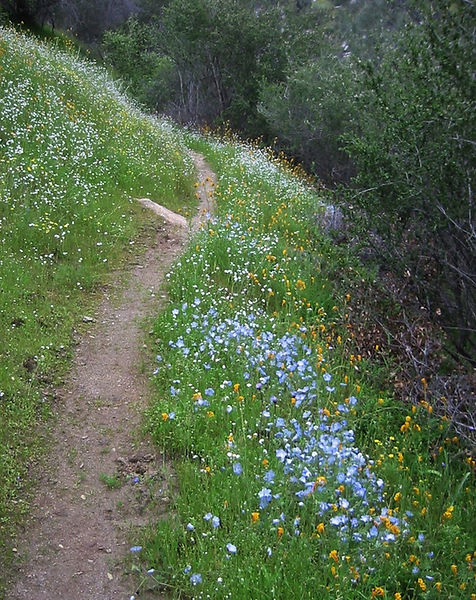


Ithuriel's Spears, Fiesta Flowers, Chinese Purple Houses
THE ORIOLE
Words and Music by Jim Robbins
This afternoon the rain pummels
the purple Chinese houses, stripping
the petals from their stems. The storm
drives the spring birds back to their nests.
The splendor hurts, thanks to the grayness
of the daily grind, and because my love
is gone and no one else
is here to share it.
It doesn't bother me now
to sit still by the creek,
dying out of myself, just
flowing water and oak woodlands
because we are not bounded
by minutes, and generations
may pass, or only moments.
A creature with merciless jaws
is nearby, but the oriole
has returned in the sunlit rain,
flitting from branch to branch,
singing a little.
Suite No. 5, Third Movement:
THE ORIOLE
“The Oriole” was inspired by a storm in Watt’s Valley, a small foothill valley near Fresno. In late April and May, a stunning array of wildflowers dominates the north-facing slopes: tier upon tier of Chinese purple houses, interwoven with pink fairy lanterns and bright yellow tarweed, crowned by umbels of Ithuriel’s Spears. We always called Ithuriel’s Spears by their less common name, “Walley baskets,” because my wife thought the name was much cuter and more descriptive. That day, I remember, the rain fell so hard that we were afraid the flowers were going to be stripped of their petals. Just before we left, an oriole arrived in sunlit rain, and we were glad that we had come to the creek despite the marauding storm. After my wife left me, I rewrote the lyrics to suggest that only I was there that day.
The same array of wildflowers had a special significance for us. A slope next to Watt’s Valley Road one year teemed with these flowers, and I pulled the car over, ravished by their beauty. We got out and gazed at the flowers for a while, and I turned to my wife and exclaimed, “There is a God,” which is not something that I would have said lightly at the time since I was an avowed agnostic who vacillated toward atheism on more than one occasion. My wife told me that God speaks to us through signs, one of them being the beauty in nature. My wife and I affectionately referred to the slope as the “God Hill” from then on whenever we passed because it was one of the first signs of my spiritual emergence.
My wife liked two lines in the song especially, the one about dying out of the self in order to experience a greater awareness of God in nature, and the one about “the creature with merciless jaws” being nearby, which she recognized as a symbol of death. She interpreted the line to mean that the recognition of our own mortality helps us to become aware of the presence of God in the natural world. She liked to say that you cannot see birds or flowers unless you have them in your heart, and I realized, based on our experience, that she was also implying that if you can see the beauty of flowers and birds, then you can also know God in your heart.

Native American Land (The Gorge)
FARTHER
Words and Music by Jim Robbins
Once we walked on many paths
and found the pounding stones,
and we knew that each path
goes farther back into the past
than we could ever hope to go.
Once we held each other close
and waited out the storm.
When we looked into each other's eyes
we knew that they were deeper
than we could ever hope to plunge.
Once we climbed higher
than we had ever hoped to go,
but the cliffs all around us
showed that we could not hope
to ever go any higher.
Now you've left, and I wonder
if you went farther
than I could ever hope to go,
or if you just could go no farther.
Suite No. 5, Fourth Movement:
FARTHER
My wife left me after thirty years of marriage to rekindle an adolescent romance with a man she had known over forty-five years ago. When they were teenagers, their relationship had ended when he fled to Canada to dodge the draft (which I find laudable since I have always believed that the Vietnam War was an abomination). He is an artist who paints murals of undersea and forest environments on the walls of houses. (Since I am also an artist, I can appreciate his work.) He lives in Florida and has a sister in North Carolina. That’s all I know about him.
My wife found him again on Facebook at a time when she was reconnecting with a lot of old high school friends. A few months ago, after I discovered his name on her phone, I went to his website, which shows some of his murals, and I discovered that she had lavished praise on his work three years before.
My wife is usually a responsible person, which makes it hard for me to understand her behavior. I have my theories, but they are all colored by negative feelings. I am striving to be as objective as I can, but the more dispassionate I become, the less I understand it. She loves her children and grandchildren, who all live in California, so pulling up roots and moving to Florida is a dramatic move for her.
My wife’s father died a year ago, and her mother was also dying at a time when I appeared to be going down the tubes due to my chronic illness. I have often wondered if my wife was simply escaping from death and disease.

Trough
THE SUN IN THE TROUGH
Words and Music by Jim Robbins
I want to take you down
to the stream which snakes
below the ridges crowned
by pounding stones.
Near a spring, a trough abides,
Sept. 23, 1924 scribbled in cement.
The sun sparks my crown in the trough,
illuminating my subtle body.
I want you to see
the sun at our crowns
radiating down
into our hearts.
That light joining
our hearts together
as ten minutes pass
or ten thousand years
until we remember
that we are as timeless
as water, blackberry
brambles, quail grass.
Suite No. 5, Fifth Movement:
THE SUN IN THE TROUGH
I have sometimes wondered if I was deluded for thirty years.
Can you truthfully claim that you know what the people closest to you are thinking and feeling as they go through difficult times? Can you say for certain that even after thirty years of marriage your spouse would stay with you if he or she received an inheritance of a million dollars? What if one of your spouse’s parents died, and your spouse came face to face with his or her own mortality for the first time? What if you became seriously ill and your spouse didn’t know how to deal with it? What if your spouse totally hated his or her job? Would your spouse stay by your side if a chance for a new life suddenly materialized?
My wife found out that she would receive an inheritance of a million dollars after her father died. Her brother, an accountant, provided her with the first installment of over three hundred thousand dollars a year later. Though her father was in his nineties, my wife was deeply shaken by his death, possibly because no one else close to her had ever died before. Her mother, who is in her late eighties, has also nearly died recently on two occasions.
My wife thoroughly despised her teaching job. She had over 200 students a semester, most of whom didn’t care about learning or were openly hostile. Her school district was so concerned about suspension rates that it allowed chronically disruptive and defiant students to remain in school even though the disruptive students kept making it impossible for teachers to teach or students to learn. Administrators were allowing the worst elements in each class to take over, and both the teachers and the good students struggled in a climate of fear. Even so, administrators constantly evaluated the teachers and blamed them for the behavior problems. My wife felt like she had to devote sixty to seventy hours a week on planning, grading, and dealing with behavior problems just to keep her head above water. She usually couldn’t sleep more than four hours a night due to the stress, and she was totally wiped out by the end of each school year.
“The Sun in the Trough” is one of my favorites. The song initially had different lyrics, which I changed after I experienced a profound sense of timelessness as I gazed into a trough in the middle of nowhere. In the water in the trough, the sun blazed just above my head. In the reflection, my body was a shadow, but the sun seemed to illuminate my aura. I wanted to show the place to my wife, but she never hiked the three miles to the Native American village site where I found the trough. In fact, she stopped singing the song after I changed the lyrics.
I have many times experienced a sense of timelessness in nature. Sometimes, I believe that a profound sense of connection with another person, even though it may not be enough to maintain a relationship, at least can keep a person going in the worst of times. Even though I feel abandoned by the person I loved, I know that the sun at the core of every person is eternal. The personality is transient, merely an illusion, and that is true for relationships sometimes as well.

Secret Native American Path on Ridge
SECRET PATHS
Words and Music by Jim Robbins
Now we know all the secret paths
along the river. Today the ravens
are gone, so are the butterflies
that jeweled the sand.
Graffiti defaces the rock,
and trash, too much for us
to clean up, covers the little beach
where we once were alone.
We have forgiven each other
so much that forgiveness hardly matters
anymore, the bats softly
flitting around us, skimming
the water as the skyline begins
to glow, the pure, intense moon
rising behind a bare oak.
Now we know all the secret paths
along the river, the bats softly
flitting around us, skimming
the water as the skyline
begins to glow, the pure,
intense moon rising, its
terrible craters so clear
in the cold
still air.
Suite No. 5, Sixth Movement:
SECRET PATHS
“Secret Paths” was one of my wife’s favorite songs. Years ago, we traveled almost every weekend to the North Fork of the Kaweah River. We especially loved a spot that no one else knew about, or so we thought. We were so confident that we were alone that one day we decided to go skinny dipping. We swam, shocked into motion by snowmelt, to the other side, and then back again. Just as we were sloshing out of the water, we heard laughter from the trail above. I sprinted up the hill on sharp oak leaves and hid behind a bush. She dashed off in a different direction. After a while, I noticed her fully clothed down below, pacing back and forth next to the river. Even seeing her in the distance, I was still unsure about stepping out of the shade. Finally, I inched toward the beach and quickly dressed while the intruders were struggling upriver against the current. My wife was mad at me for making her wait so long.
That evening we watched the moon rise above the mountain as bats skimmed the surface of the water. The battered moon silhouetted a bare oak at the top of the hill. Later I saw that as a perfect symbol: Everything gets battered by experience—sometimes through suffering we learn to sympathize with others and appreciate the moment. And I realized that my wife and I understood each other so well that we hardly ever needed to forgive each other anymore. My wife at one point loved to sing this song. Perhaps the theme resonated with her to some degree, but at this point, I'm not so sure about what might have been our ability to forgive each other.